# Bitcoin Slots Guide: How Deposits, Odds and Risks Work
Bitcoin slots explained: how BTC deposits work, what provably fair really proves, and the chance-based risks to check before you play.
Author: CryptoGameRank Editorial
Published: 2026-11
Updated: 2026-11
Canonical: https://cryptogamerank.com/blog/bitcoin-slots
If a casino calls its games Bitcoin slots, does that mean you're wagering Bitcoin, or just sending Bitcoin into a system that converts it into something else? That distinction matters as much as the reels. Understanding the **payment layer** and the **game layer** separately helps you assess what you're spending, how outcomes are produced, and which risks a fairness claim leaves unresolved.
## Table of Contents
- [What Bitcoin Slots Are and Why Players Use Them](#what-bitcoin-slots-are-and-why-players-use-them)
- [Why the payment method attracts attention](#why-the-payment-method-attracts-attention)
- [Bitcoin Versus Stablecoin Funding Compared](#bitcoin-versus-stablecoin-funding-compared)
- [Follow the asset through the cashier](#follow-the-asset-through-the-cashier)
- [How Slot Outcomes, RTP and Volatility Work](#how-slot-outcomes-rtp-and-volatility-work)
- [Random numbers must become correct outcomes](#random-numbers-must-become-correct-outcomes)
- [RTP isn't a session forecast](#rtp-isnt-a-session-forecast)
- [What Provably Fair Does and Does Not Prove](#what-provably-fair-does-and-does-not-prove)
- [How the commitment works](#how-the-commitment-works)
- [Separate reproducibility from trust](#separate-reproducibility-from-trust)
- [Verification Checks Before You Play](#verification-checks-before-you-play)
- [Read the scope, not just the logo](#read-the-scope-not-just-the-logo)
- [Don't overlook features or account controls](#dont-overlook-features-or-account-controls)
- [How to Deposit and Withdraw Bitcoin Safely](#how-to-deposit-and-withdraw-bitcoin-safely)
- [Follow the transfer from wallet to cashier](#follow-the-transfer-from-wallet-to-cashier)
- [Know when to escalate](#know-when-to-escalate)
- [Set Your Limits Before You Deposit](#set-your-limits-before-you-deposit)
- [Write a session agreement with yourself](#write-a-session-agreement-with-yourself)
- [Recognize when the purpose has changed](#recognize-when-the-purpose-has-changed)
## What Bitcoin Slots Are and Why Players Use Them
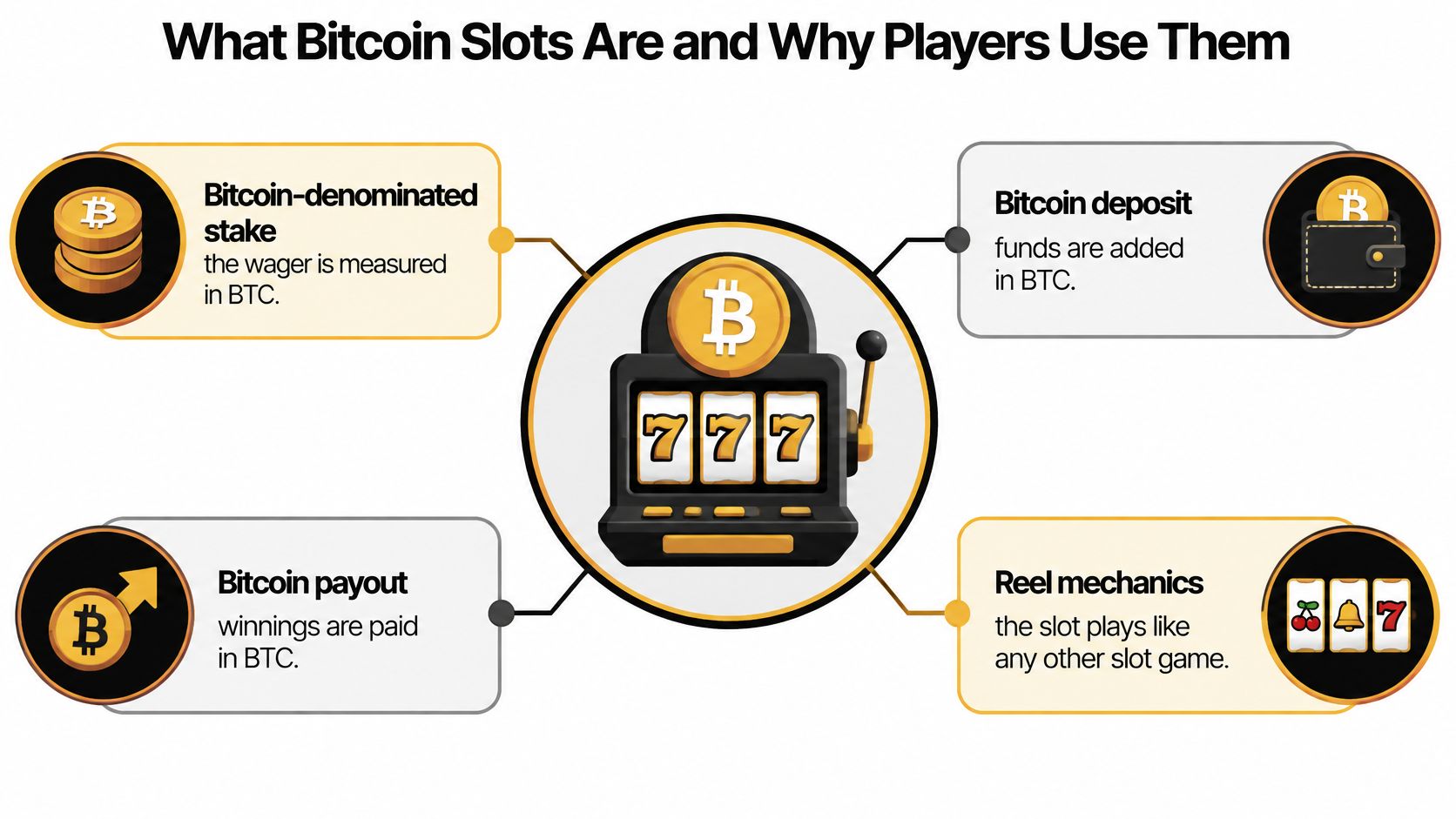
In the strict sense, a **Bitcoin slot** is a slot game whose deposit, stake, and payout are denominated in Bitcoin, usually abbreviated **BTC**. The symbols, paylines, bonus rounds, and spin controls work like those of other online slots. What changes is the money used to fund and settle play.
Think of a vending machine adapted to accept another currency. The mechanism inside still dispenses the same products, but you now need to understand the currency accepted at the front. A Bitcoin-themed game isn't necessarily Bitcoin-funded, just as a machine decorated with foreign banknotes doesn't necessarily accept them.
The distinction is easier to see when deposits, stakes, and payouts are separated.
### Why the payment method attracts attention
A player who already holds BTC might prefer funding a balance from a cryptocurrency wallet rather than using a bank card. Another might want to receive withdrawals in the asset they already hold. Neither preference tells you whether the slot itself offers suitable terms or reliable controls.
In a **2024 quantitative study cited by the [UK Gambling Commission](https://www.gamblingcommission.gov.uk/print/illegal-online-gambling-phase-2-identifying-indicators-of-consumer)**, **9% of respondents who gamble** reported depositing cryptocurrency such as Bitcoin to gamble on a website. That's self-reported payment use across the surveyed gambling population, not a count of Bitcoin-slot players or a global market-share estimate.
Crypto casinos commonly group slots with live casino, instant games, and sports betting. A payment-use figure therefore can't tell you which product someone played.
> **Practical rule:** Treat the Bitcoin label as a reason to investigate the payment setup, not as evidence about game quality.
When opening a platform overview such as the [Crashino review](https://cryptogamerank.com/reviews/crashino), distinguish a description of available products from proof of how individual wagers settle. We use public-source overviews rather than tested casino endorsements.
The useful starting point is simple: **ordinary slot mechanics, a potentially different payment arrangement, and separate checks for each**.
## Bitcoin Versus Stablecoin Funding Compared
**Funding assets compared for Bitcoin slot deposits**
| Funding Asset | Share of On-Chain Gambling Volume | Main Exposure | What to Check Before Sending |
|---|---|---|---|
| Native Bitcoin (BTC) | 36% in 2022, roughly 2% in 2025, according to the [ClearCasinos adoption report](https://clearcasinos.com/reports/crypto-casino-adoption-2026) | The stake's local-currency value moves with BTC; confirmation delays | Required confirmations, network fee, and minimum deposit on the cashier page |
| Stablecoins (USDT, USDC) | Stablecoins collectively represented about 70% of cumulative on-chain gambling volume in the same report | Issuer and redemption risk, depeg risk, and chain selection | Exact token, network, and whether the site accepts it directly |
| BTC converted on deposit | No separate share stated | Conversion rate and fee applied when funding | Whether conversion terms appear before you authorize the transfer |
The stablecoin figure describes the category as a whole, not a separate measured share for each named token. These are also **on-chain gambling measures**, not slot-specific measures or an inventory of every casino's funding arrangements.
### Follow the asset through the cashier
With **native BTC funding**, your balance remains exposed to Bitcoin's price. You might finish with the same amount of BTC yet find that its local-currency value has changed. That's separate from anything won or lost on the reels.
With **stablecoin funding**, a dollar-pegged token aims to keep a closer relationship to the dollar. That can make a bankroll easier to interpret, but it doesn't make the funds risk-free. Consider the issuer's ability to honor redemption, a possible loss of the peg, and whether you've selected the supported blockchain.
With **automatic conversion**, sending Bitcoin doesn't necessarily create a Bitcoin balance. The operator might credit a fiat-denominated account or another asset, using a conversion rate and possibly a fee. A later BTC withdrawal could require another conversion.
A site can therefore advertise Bitcoin while emphasizing USDT or USDC in its cashier. The decisive information is the **asset debited for each wager and credited for each payout**, not the headline on the homepage.
> Before authorizing a transfer, be able to name the deposit asset, account-balance asset, wagering asset, and withdrawal asset.
Network fees and confirmation requirements belong in that assessment too. Don't assume that different tokens, or different networks carrying a similarly named token, share the same transfer conditions.
Keep transaction records showing the asset amount, conversion rate, fees, and local-currency equivalent. Where wagers settle in BTC, record stakes in BTC and local currency; where conversion occurs, retain both sides of the conversion. Those records can help with accounting and with any tax obligations that apply where you live.
## How Slot Outcomes, RTP and Volatility Work
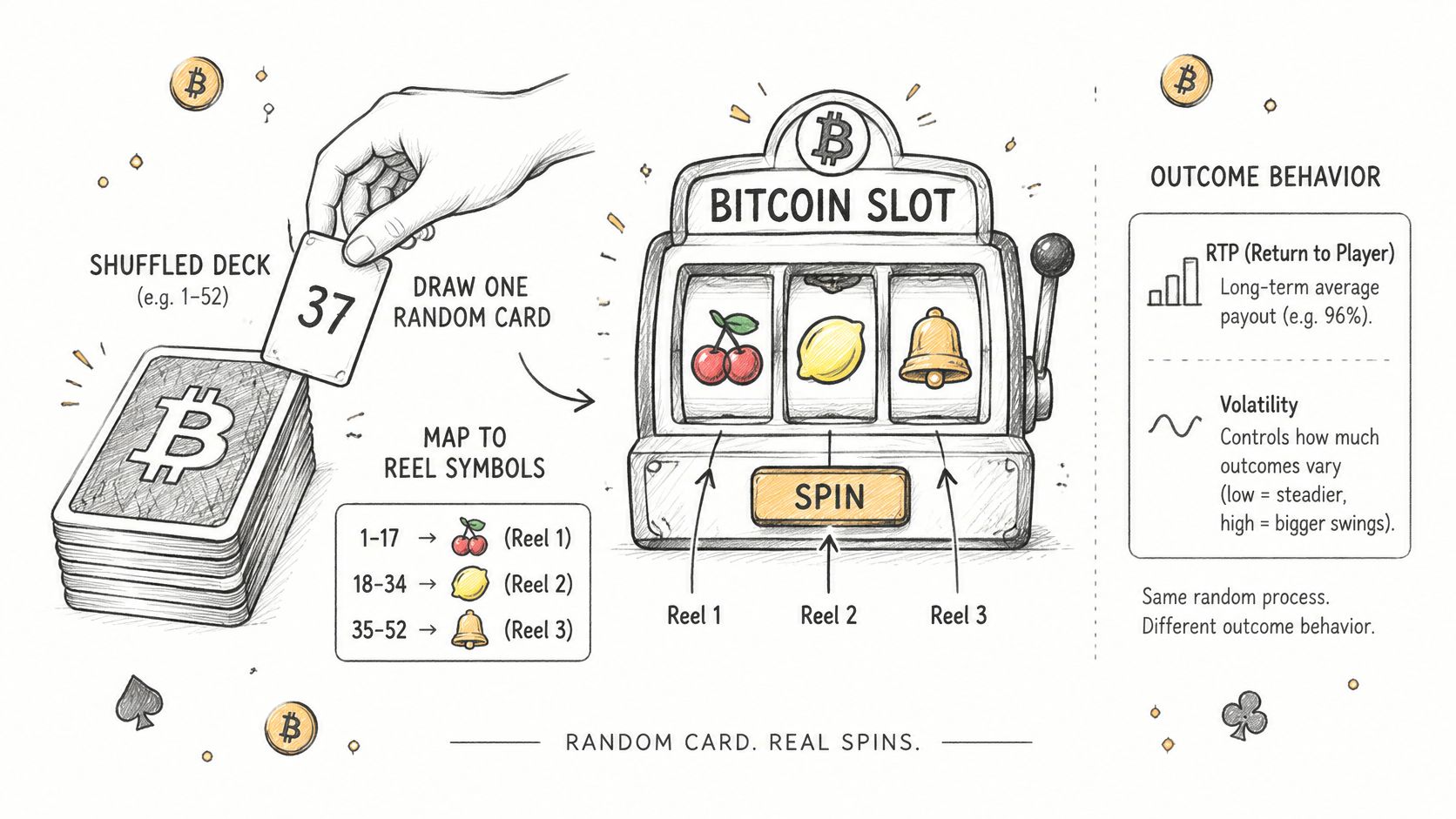
A digital slot doesn't need physical reels to choose a result. Its software obtains a random value, then uses game rules to translate that value into reel positions, symbols, and any resulting award.
A shuffled deck offers a useful analogy: randomness determines the draw, while the rules determine what that draw means. It isn't a literal description of a slot's implementation.
### Random numbers must become correct outcomes
The [UK Gambling Commission's random-outcome standard](https://www.gamblingcommission.gov.uk/standards/remote-gambling-and-software-technical-standards/rts-7-generation-of-random-outcomes) requires uniformly distributed RNG output, mapped outcomes consistent with theoretical probabilities, computational unpredictability without the algorithm and seed, and streams that don't repeat or synchronize across instances.
That makes **outcome mapping** as important as the random-number generator, or **RNG**. Software can generate sound random values but translate them into game outcomes incorrectly.
One technical problem is **biased range reduction**. If developers use a flawed remainder, or modulo, operation to squeeze a random integer into a smaller symbol range, some symbols can receive more possible inputs than others. Rejection sampling or another unbiased mapping method prevents that imbalance.
### RTP isn't a session forecast
**Return to player**, or **RTP**, describes the game's theoretical long-run return relative to the amount wagered. As a hypothetical illustration, a game with a stated return slightly below the total staked would still allow individual sessions to finish well ahead or far behind that expectation.
**Volatility** describes how payouts are distributed. A higher-volatility design may concentrate returns in less frequent, larger awards, while another game distributes more of its returns through smaller wins. Similar RTPs therefore don't imply similar session experiences.
Use the accompanying video as an additional explanation of the game process, not as certification of any particular operator.
A blockchain transaction can establish that funds moved between addresses. It can't independently establish that the reels were random.
For a meaningful game assessment, request:
- **Published RTP** for the actual game configuration.
- **Stated volatility** or a clear description of payout distribution.
- **RNG documentation** explaining the outcome-generation method.
- **Mapping evidence** connecting random values to the implemented game rules.
## What Provably Fair Does and Does Not Prove
**Provably fair** sounds like a complete assurance of trustworthiness. In practice, it's a narrower technical claim about whether a player can verify a result using disclosed inputs and an identified algorithm.
The [DeucesCracked explanation of provably fair gambling](https://www.deucescracked.com/blog/provably-fair-gambling-explained-algorithm-data) describes verification using server seeds, client seeds, and a bet nonce, while noting that externally supplied slots and live-dealer games may not support the same process. A label on a casino homepage therefore doesn't establish coverage for every game in its lobby.
### How the commitment works
In a typical implementation, the operator publishes a **hash commitment** to a secret server seed before play. The player supplies or selects a **client seed**, while a **nonce** distinguishes successive bets.
After the operator reveals the server seed, a verifier can check that it matches the earlier commitment and recompute the result from the inputs. The commitment is intended to prevent the operator from substituting a different server seed after seeing the bet.
For meaningful verification, save the original commitment and relevant bet inputs. Confirm the algorithm, the point at which seeds are revealed, and whether seed rotation follows the stated procedure.
### Separate reproducibility from trust
A useful assessment distinguishes these questions:
- **Can I reproduce the outcome?** The disclosed inputs and algorithm should produce the recorded result.
- **Is the advertised return accurate?** That requires examining probabilities, payouts, and the full game implementation.
- **Can I rely on the operator's protections?** Licensing, fund handling, identity safeguards, complaint routes, and responsible-gambling controls need their own evidence.
Suppose a player recomputes an outcome and gets an exact match. The proof passes, but it doesn't establish that the published paytable accurately describes the implemented probabilities. Nor does it establish that bonus conditions are reasonable or that the operator will honor a withdrawal.
> A reproducible result isn't a promise that your account balance is protected or your withdrawal will be paid.
Don't assume a proprietary instant game's verification tool also verifies a third-party slot. Identify the exact game covered, establish which inputs and calculations the proof includes, and list what remains dependent on the operator or studio. If the verification stops at a random value, ask how that value becomes the displayed slot result.
## Verification Checks Before You Play
**Pre-deposit checks for a Bitcoin slot**
| Check | What It Confirms | Red Flag |
|---|---|---|
| Published RTP and volatility | Expected long-run return and how payouts cluster | No RTP shown, or inconsistent information between game help and paytable |
| RNG or provably fair method | Whether outcomes can be reproduced or independently tested | Only a certification badge, without supporting evidence |
| Third-party test house report | Independent assessment of RNG output and mapping | No named test house, or an older report without confirmation that it covers the current build |
| Paytable and probability match | Implemented outcomes agree with documented probabilities and payouts | Paytable can't be reconciled with tested RTP |
| Bonus-feature RTP | Free spins and bonus rounds are included in the stated overall return | Only base-game RTP is published |
| Licensing and jurisdiction | Which regulator applies and whether the operator can serve your location | Availability claims without an identifiable licence or regulator |
| Withdrawal terms | Minimums, limits, and processing windows for BTC payouts | Conditions aren't disclosed before deposit |
The [UK Gambling Commission's testing procedure](https://www.gamblingcommission.gov.uk/strategy/testing-strategy-for-compliance-with-remote-gambling-and-software-technical/2-procedure-for-testing) identifies unfair RNG output and incorrect scaling or mapping as financial-loss risks and requires an approved third-party test house to analyze RNG outputs before release. For readers, the important distinction is between **an identifiable report with a defined scope** and an unsupported badge.
### Read the scope, not just the logo
Check the game name, software version, tested configuration, and issuing organization. An older report isn't automatically irrelevant, but don't assume it covers changes made afterward. Look for documented confirmation that the build you're playing remains within its scope.
Useful technical work includes **chi-square or comparable distribution tests**, alongside **serial and runs tests** that examine dependence between outputs. Statistical testing should complement scrutiny of the mapping and outcome-selection logic, rather than stopping at raw random numbers.
### Don't overlook features or account controls
Bonus rounds can materially affect the overall payout model. A report or help screen describing only base spins doesn't establish the return of the complete game.
Licensing and withdrawal checks answer different questions from mathematical testing. Inspect the regulator's own register where available, and read identity-verification, custody, and withdrawal conditions before transferring funds.
An editorial overview such as the [Bitstarz review](https://cryptogamerank.com/reviews/bitstarz) can prompt further questions, but we didn't open accounts, make deposits, or test payouts when preparing our platform reviews.
Use the table as a deposit gate, not a scoring contest. **An unresolved red flag is a reason to pause**, particularly where legal eligibility, access to funds, or the identity of the operator is unclear. Passing other rows doesn't cancel a serious failure.
## How to Deposit and Withdraw Bitcoin Safely
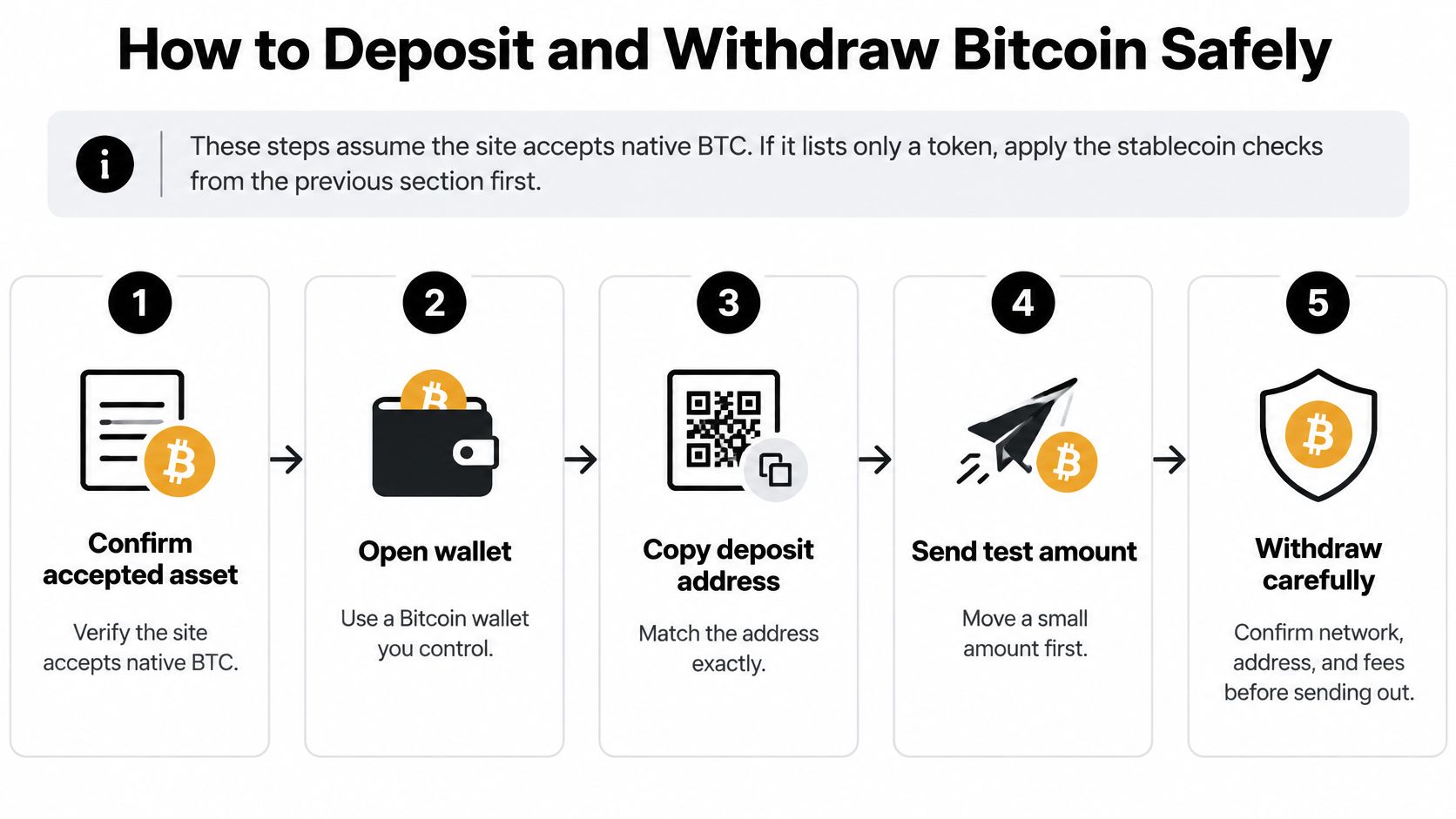
These steps assume the cashier accepts **native BTC**. If it lists only a token, first verify its exact identity and supported network using the funding checks above. Don't treat a similarly named asset as interchangeable with Bitcoin.
This process map highlights the transfer checks that deserve attention before money moves.
### Follow the transfer from wallet to cashier
1. **Confirm the accepted asset and network.** Open the cashier's deposit instructions and check whether it accepts native BTC or converts the deposit. Read the resulting account denomination before generating a payment address.
2. **Read the crediting conditions.** Check the minimum deposit, your wallet's network-fee estimate, and the confirmations required for crediting. Make sure a test transfer will exceed the stated minimum after any applicable deductions.
3. **Prepare a wallet you control.** Secure its recovery information offline and never give a casino or support agent your recovery phrase or private keys. Copy the deposit address from the authenticated cashier and compare the full address with your wallet's destination field before approval.
4. **Send a small test transfer.** Wait until both the blockchain transaction and the casino credit are visible before sending more. If your wallet shows no transaction ID, investigate whether the transfer was broadcast rather than assuming it is pending on-chain.
5. **Apply your session budget before playing.** Enter the stake deliberately and confirm the displayed unit, especially if the interface uses a smaller Bitcoin denomination. Disable automatic play while checking unfamiliar controls.
6. **Withdraw to a compatible address you own.** Confirm the withdrawal asset, network, fee, and destination independently. The receiving address needn't match an earlier deposit address, but it must support the asset and network being sent.
7. **Retain the transaction ID and follow its status.** Use a Bitcoin block explorer to inspect a broadcast transaction and your receiving wallet to confirm arrival. Never post private wallet credentials when asking for help.
### Know when to escalate
A withdrawal may remain in the operator's internal processing queue before there's a blockchain transaction ID. Once broadcast, its confirmation status should be independently inspectable.
If the stated processing window passes, contact support with the request reference, timestamp, asset, and transaction ID if available. Don't send an extra deposit to supposedly release a withdrawal.
When researching a platform through the [Block Spin overview](https://cryptogamerank.com/reviews/block-spin), verify current cashier instructions directly rather than assuming a public description guarantees today's payment workflow.
## Set Your Limits Before You Deposit
The strongest decision you can make about Bitcoin slots happens before the first spin: **decide what you're prepared to lose, and make that decision enforceable**. Slots are chance-based games. Changing spin timing, chasing a losing sequence, or raising stakes doesn't give you control over the next result.
A betting pattern can't remove a game's mathematical house edge. Your practical controls are the amount exposed, the pace of play, and the point at which you stop.
### Write a session agreement with yourself
Choose an entertainment amount that can be lost without affecting rent, bills, debt payments, savings commitments, or anyone who depends on you. If no such amount is available, don't deposit.
Convert that budget into BTC using the rate available when you fund the session, and save the local-currency value alongside it. Treat any later increase in Bitcoin's price as a change in asset value, not permission to spend beyond your original limit.
Write down:
- **Maximum spending:** The entire amount available for the session, including relevant funding costs.
- **Stopping time:** A fixed end time or predetermined spin limit.
- **Loss threshold:** The balance or loss level at which you close the game.
- **No top-ups:** No additional deposit during the session, even after a near miss or an early win.
Use deposit limits, session reminders, time-outs, or self-exclusion tools where available. Don't rely on a note alone if you know you'll be tempted to override it.
### Recognize when the purpose has changed
Chasing losses, raising stakes after losing, and playing specifically to recover a deposit are warning signs. So are hiding expenditure or treating money needed elsewhere as a temporary gambling loan.
If those behaviors appear, stop playing rather than negotiating a larger limit with yourself. Seek support from a local gambling-help service, and consider blocking access or using self-exclusion while you arrange that support.
Our responsible-play guidance emphasizes **setting limits, never chasing losses, and seeking help when gambling stops feeling like entertainment**. Our index is marked **18+ only** and is editorial, not a gambling service or a recommendation to participate. Research any platform independently and check the rules and requirements where you live.
Today, complete the pre-deposit checklist and write down your session limits before opening a cashier. If every check is satisfactory and participation is lawful for you, a small test session remains optional, not an obligation. **If any check fails, don't deposit.**
---
[CryptoGameRank](https://cryptogamerank.com) offers an editorial index and public-source platform overviews to help organize independent research into crypto-gaming services. Visit to compare starting points, then use the payment, fairness, and withdrawal checks in this guide to assess each operator yourself before deciding whether to participate.
18+ only. Gambling involves financial risk; local restrictions apply.