# Crypto Casino Guide: How It Works and What to Check
Learn what a crypto casino is, how crypto gambling works, and what to check on licences, legality, withdrawals and responsible play before you deposit.
Author: CryptoGameRank Editorial
Published: 2026-11
Updated: 2026-11
Canonical: https://cryptogamerank.com/blog/crypto-casino
If a crypto casino advertises fast payments, does that mean you can get your money out quickly? Not necessarily. A **crypto casino is an online gambling service that accepts and pays out cryptocurrency**, but its account checks, withdrawal approval and player protections remain separate questions.
This CryptoGameRank guide is for adults researching how those services work. The useful starting point isn't a bonus or a payment-speed claim. It's understanding who holds your funds, which rules apply where you live, and whether you can activate meaningful safeguards before depositing.
## Table of Contents
- [What a Crypto Casino Is and How It Differs from a Regular Online Casino](#what-a-crypto-casino-is-and-how-it-differs-from-a-regular-online-casino)
- [Who controls the funds?](#who-controls-the-funds)
- [What games might be available?](#what-games-might-be-available)
- [How a Crypto Casino Session Works, Step by Step](#how-a-crypto-casino-session-works-step-by-step)
- [What should you check at each stage?](#what-should-you-check-at-each-stage)
- [What makes a usable session record?](#what-makes-a-usable-session-record)
- [Who Plays and How Much Crypto Gambling Really Involves](#who-plays-and-how-much-crypto-gambling-really-involves)
- [Why aren't wallets the same as players?](#why-arent-wallets-the-same-as-players)
- [How should you read market estimates?](#how-should-you-read-market-estimates)
- [Legal Status by Player Location and What It Means](#legal-status-by-player-location-and-what-it-means)
- [What does your situation require you to check?](#what-does-your-situation-require-you-to-check)
- [How do you verify a licence rather than a badge?](#how-do-you-verify-a-licence-rather-than-a-badge)
- [Provably Fair Claims and Identity Checks Explained](#provably-fair-claims-and-identity-checks-explained)
- [Can you reproduce the result yourself?](#can-you-reproduce-the-result-yourself)
- [Why can a wallet deposit still trigger identity checks?](#why-can-a-wallet-deposit-still-trigger-identity-checks)
- [Why Casino Approval and Blockchain Confirmation Differ](#why-casino-approval-and-blockchain-confirmation-differ)
- [Who controls each stage?](#who-controls-each-stage)
- [What should you inspect when a withdrawal stalls?](#what-should-you-inspect-when-a-withdrawal-stalls)
- [What Recourse You Have If a Crypto Casino Fails or Freezes Funds](#what-recourse-you-have-if-a-crypto-casino-fails-or-freezes-funds)
- [Which complaint route should you use?](#which-complaint-route-should-you-use)
- [Does a failed identity check permit confiscation?](#does-a-failed-identity-check-permit-confiscation)
- [Responsible Play Controls to Check Before Depositing](#responsible-play-controls-to-check-before-depositing)
- [Which controls are actually usable?](#which-controls-are-actually-usable)
- [What changes when the money is cryptocurrency?](#what-changes-when-the-money-is-cryptocurrency)
- [Confirm the Basics Before You Deposit Anything](#confirm-the-basics-before-you-deposit-anything)
## What a Crypto Casino Is and How It Differs from a Regular Online Casino
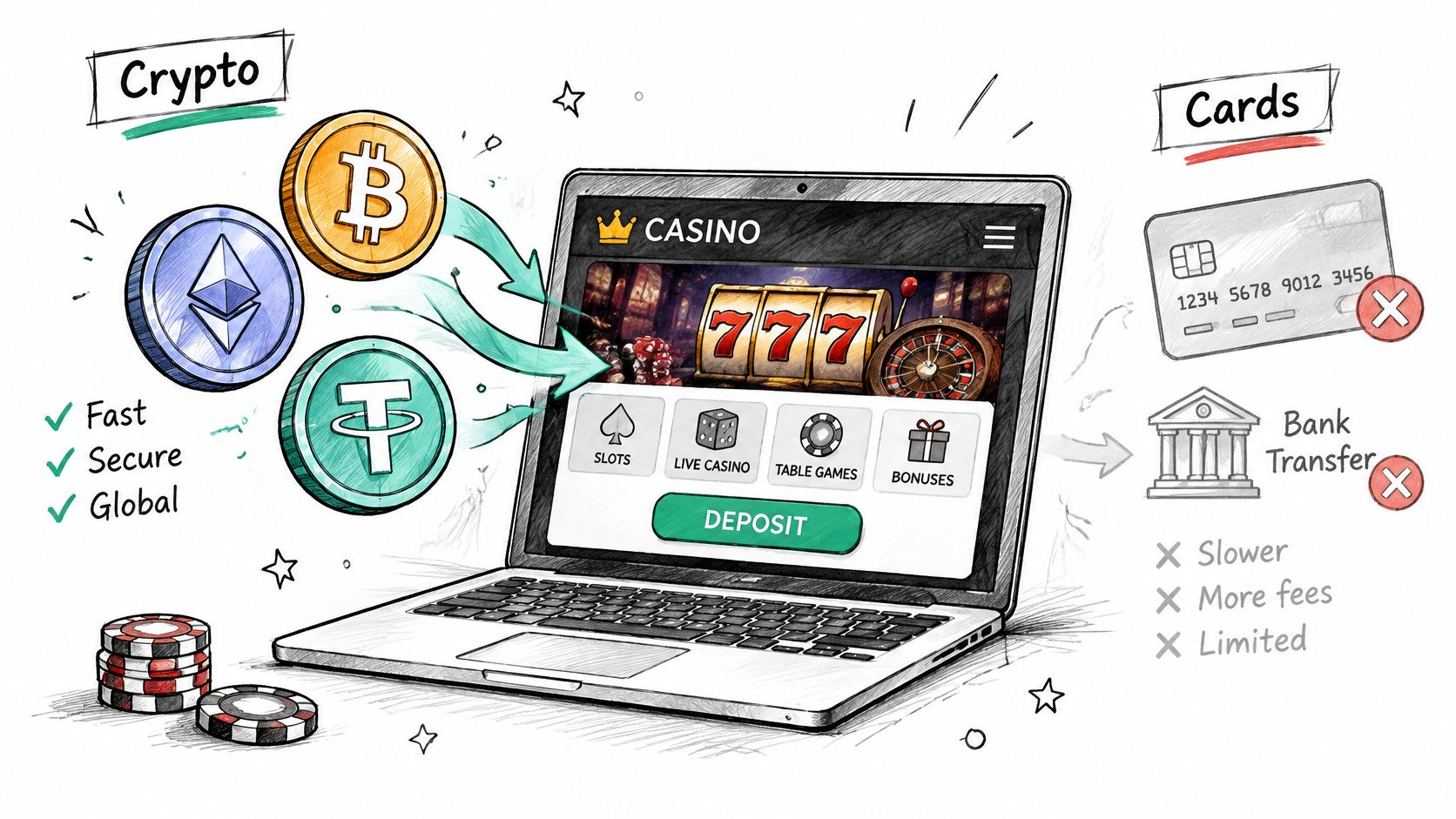
A crypto casino accepts assets such as **Bitcoin, Ethereum or stablecoins**, instead of or alongside bank cards and e-wallets. The payment method changes, but you're still staking something of value on an uncertain outcome.
Say you send cryptocurrency to a casino's deposit address. Your wallet shows the transfer, and the casino later displays a playable balance. Those aren't necessarily the same thing: the operator may hold your deposited assets while maintaining a separate account ledger for your bets.
The comparison below illustrates the different payment routes.
### Who controls the funds?
Think of a custodial casino as a bank-style vault with an internal balance sheet, **not as a protected bank deposit**. You can request money from the vault, but the operator controls its release.
Other services let you connect a wallet, while decentralized applications can use smart contracts on a network such as Ethereum. These arrangements can overlap. Connecting a wallet doesn't establish that you retain control of every asset after authorizing a transaction.
Keep these terms separate:
- **Casino account:** The operator's record of your balance, wagers and account status.
- **Crypto wallet:** Software or hardware that manages the keys used to authorize blockchain transactions.
- **Blockchain network:** The system that processes and records transfers.
### What games might be available?
Menus can include slots, live-dealer tables, instant-win crash-style games, and sports or esports betting. The operator decides which products it offers and where customers can access them.
The practical distinction is therefore **a gambling service with a crypto payment layer**, not an exemption from gambling law. Licensing, eligibility and identity requirements still need checking, regardless of whether the deposit arrives from a bank or a wallet.
## How a Crypto Casino Session Works, Step by Step
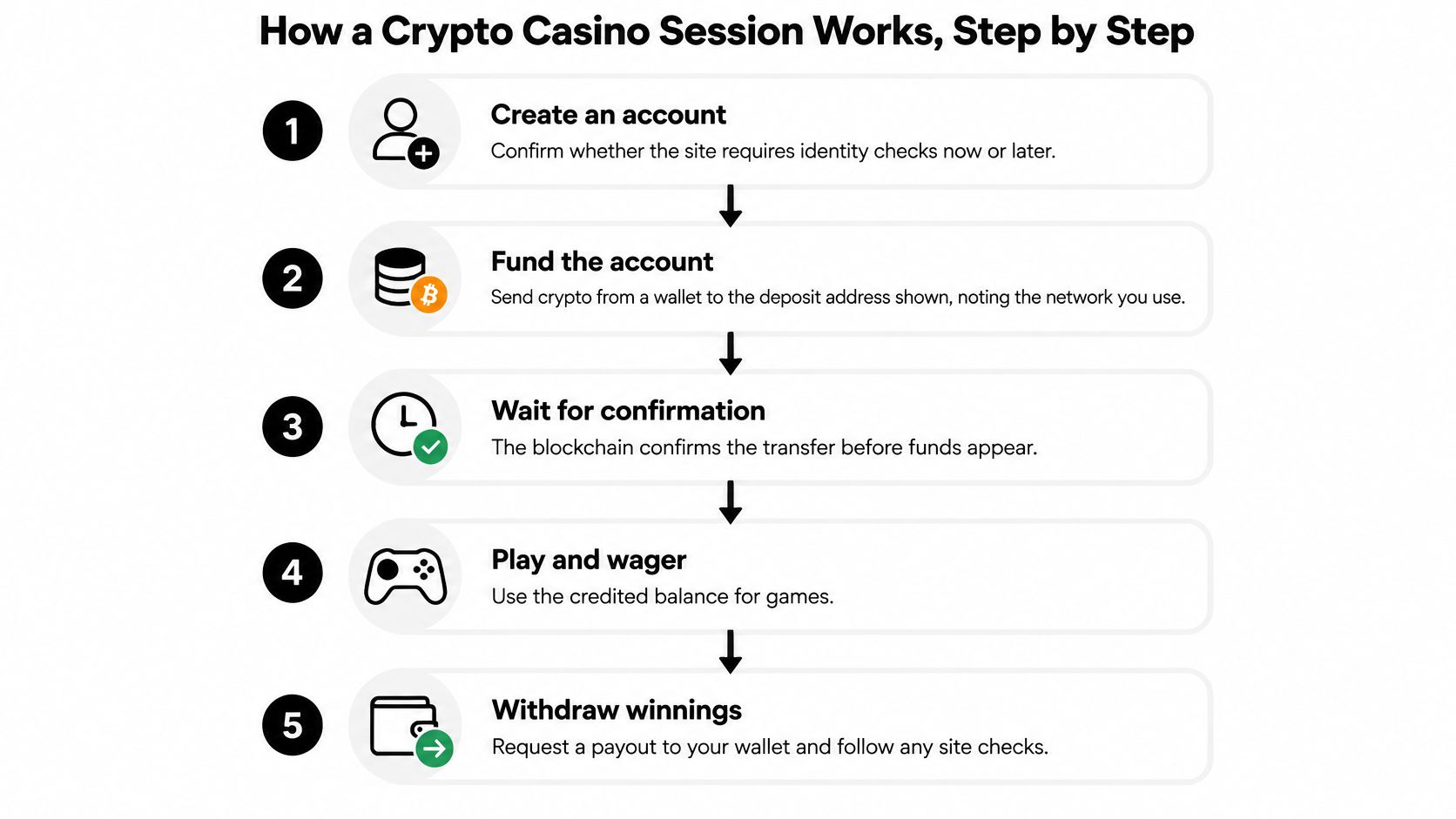
Treat a session as a sequence of decisions, not a deposit followed by play. Each stage creates information you'll need if a balance or transaction later becomes disputed.
The visual summarizes the main stages; the checklist adds the checks that are easy to miss.
### What should you check at each stage?
1. **Create an account and read the verification policy.** Establish whether identity checks happen before funding, before gambling or when additional review becomes necessary. Don't assume that being allowed to register means you're eligible to play.
2. **Match the asset and network before sending.** Copy the deposit address from the account, check its characters against the destination displayed in your wallet, and include any required memo or tag. Choosing a network merely because its name looks familiar can leave funds inaccessible or lost.
3. **Wait for the account credit.** The operator may require blockchain confirmations before recognizing the deposit, so a transfer visible in your wallet isn't necessarily playable yet. A credited deposit also isn't evidence that the casino is trustworthy or that continuing to gamble is sensible.
4. **Choose a game and set the stake deliberately.** Read the game rules, payout conditions and stated randomness method before committing funds. A common mistake is confusing a small-looking crypto denomination with a small financial exposure.
5. **Inspect the bet history.** Look for the stake, outcome, payout and round identifier, then check whether the displayed balance agrees with the recorded activity. Don't rely on the animation or a win notification as your only record.
6. **Request a withdrawal to a compatible wallet you control.** Recheck the receiving address and network rather than automatically reusing an old destination. Save the request details, then distinguish the operator's processing status from the eventual transfer.
### What makes a usable session record?
Keep the asset amount, approximate local-currency value when you played, network, transaction identifiers, account statements and game-round records. Save relevant terms and account messages too, preferably as downloadable files rather than temporary notifications.
> **Practical rule:** If you can't reconstruct where the money went and which bets changed the balance, stop before adding more funds.
Use the accompanying video as background alongside the written checks, not as confirmation of any particular operator's policies.
## Who Plays and How Much Crypto Gambling Really Involves
A typical player spent approximately **$110 in equivalent value across a median of six bets during a single day** in a 2020 academic study of three Ethereum gambling applications, covering **2,232,741 transactions, 24,234 unique addresses and 583 days**, as described in [LCB's account of the study](https://lcb.org/news/stablecoins-dominate-crypto-casino-payments). Heavily involved bettors spent approximately **$100,000 across a median of 644 bets over 35 days**.
That gap is the underlying story. The median describes a modest session, while a small group of intensely involved bettors generates activity large enough to distort any total built from raw counts. When a median day already involves six bets and the intense end reaches hundreds, whether a platform's limit tools activate matters more than whether they are listed on a settings page.
### Why aren't wallets the same as players?
An address works like a numbered wallet rather than a named account. One person can control several addresses, a single address can generate many transactions, and some of those transfers are deposits or withdrawals rather than wagers.
An address count therefore isn't a reliable headcount, and recorded spending isn't automatically net loss, since withdrawn money can return to the same holder. Anyone citing blockchain activity as proof of widespread adoption is counting wallets, not the people holding them.
### How should you read market estimates?
Published crypto-gambling estimates vary widely, largely because they measure different things. Gross gaming revenue describes wagers retained by operators after payouts. Deposits describe money entering accounts, including funds that may later be withdrawn. Transaction volume counts movement on a blockchain, where the same funds can circulate more than once. None of these figures is interchangeable with the others.
Before accepting a market-size claim, check:
- **Metric:** Deposits, wagers, transaction volume or operator revenue.
- **Period:** The dates the estimate covers.
- **Coverage:** Which operators, assets and blockchains were included.
- **Assurance:** Whether the figure was audited or independently estimated.
## Legal Status by Player Location and What It Means
Your location is a central part of determining whether you may legally use a crypto casino. An operator's registration abroad doesn't automatically authorize it to serve you, and a website accepting your registration doesn't establish permission.
The [International Federation of Horseracing Authorities' cryptocurrency report](https://www.ifhaonline.org/AibResources/Papers/Unregulated_and_unstoppable_cryptocurrencies_report_FINAL_.pdf) describes online casino games as legal in **only seven US states, none permitting cryptocurrency gambling**, and reports crypto-deposit acceptance among **43% of the 100 most popular betting websites assessed as operating illegally**, compared with **5% of sites assessed as operating legally**. These are the report's findings, not a substitute for checking the law applicable when you intend to play.
### What does your situation require you to check?
For UK-licensed operators, the [UK Gambling Commission's customer identity verification condition](https://www.gamblingcommission.gov.uk/licensees-and-businesses/lccp/condition/17-1-1-customer-identity-verification) requires verification before gambling and advance disclosure of the documents or information that might be requested. A permanently verification-free service isn't compatible with those requirements.
**Legal status and checks by player situation**
| Player situation | What the research shows | What to check first |
|---|---|---|
| Player in the United States | The cited report describes state-limited online casino authorization without permission for cryptocurrency gambling | Whether your state permits online casino play and whether the operator names a regulator covering your location |
| Player in the UK on a UK-licensed site | Identity must be verified before gambling, and required documents must be disclosed before deposit | Licence holder shown on the site and the stated verification policy |
| Player using an offshore operator | The cited report found substantial crypto-deposit acceptance among websites assessed as operating illegally | Legal entity name, licence holder, complaint body and restricted countries |
### How do you verify a licence rather than a badge?
Search the regulator's official register using the legal entity and licence details displayed by the operator. Match the website domain and authorized activities, rather than accepting a regulator's logo as sufficient evidence.
Then establish whether the authorization covers customers in your country and whether the named complaints body can hear your dispute. Save the restricted-countries terms that applied when you considered registering.
An offshore licence may leave you with difficult enforcement questions if the operator disappears. Public blockchain records can document a payment, but they don't establish solvency, chargeback rights or a usable legal remedy.
Our pages state that crypto gaming involves risk and may not be available in every location. A clear licence also doesn't remove your own legal obligations or potential tax duties.
This is general information, not individualized legal advice. Check your jurisdiction's current official rules and retain their publication or update dates; no live, platform-specific licensing determination is made here.
## Provably Fair Claims and Identity Checks Explained
**Blockchain use doesn't prove that a game is fair.** A payment can be publicly recorded while the game outcome comes from an opaque system controlled by the operator.
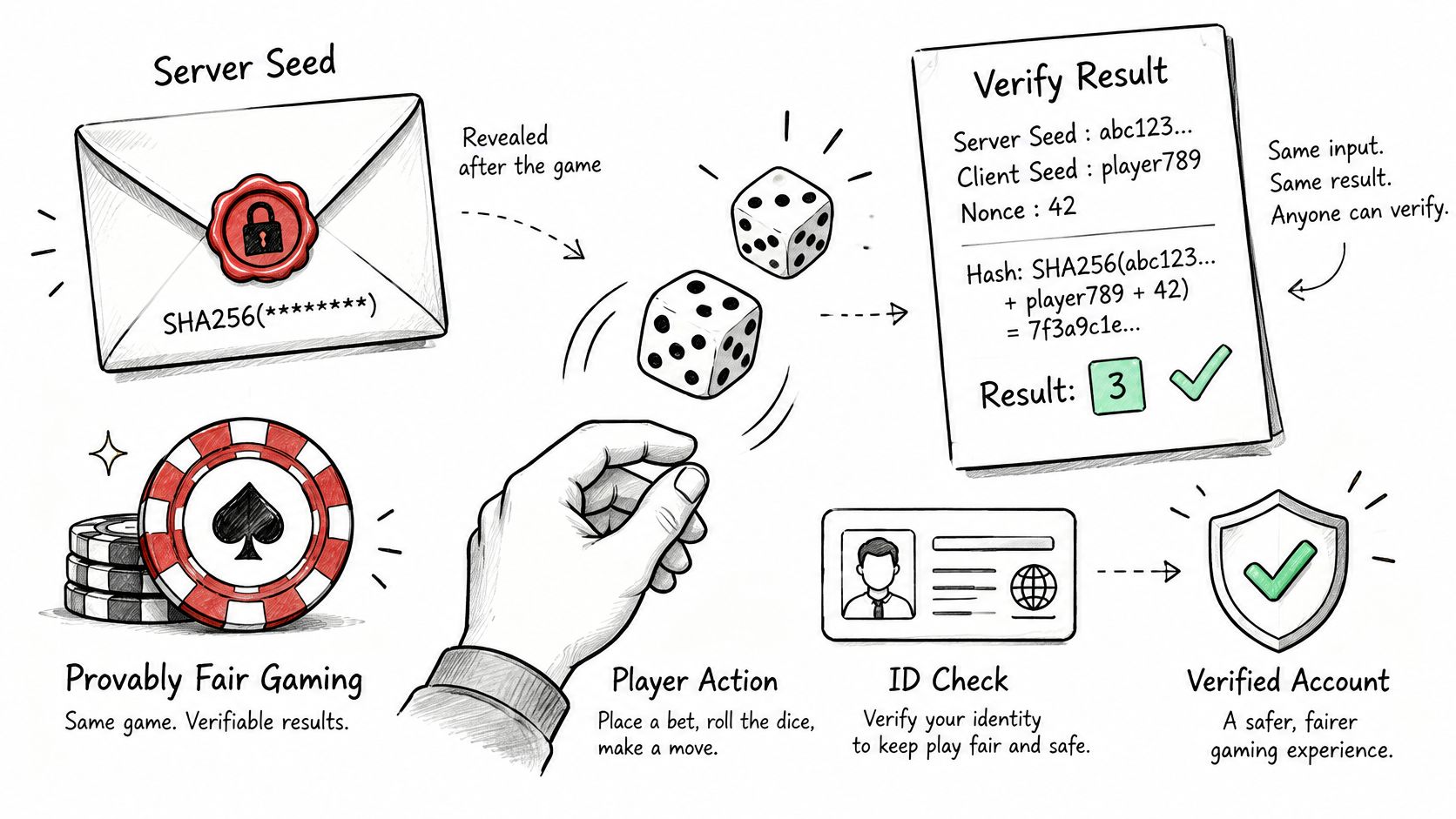
A credible provably fair design lets you verify a specific result. The operator commits to a hidden **server seed** before you act, commonly by publishing its cryptographic hash, then combines that seed with a **player seed** and a **nonce**, a value distinguishing successive rounds.
This illustration shows the verification sequence.
### Can you reproduce the result yourself?
After the server seed is revealed, the published calculation should let you recreate the outcome. Check that its hash matches the earlier commitment and that the game documents its seed rotation, nonce handling and outcome conversion.
- **Reproducible calculation:** Look for the complete algorithm and inputs, not just a fairness badge.
- **Contract permissions:** Establish whether deployed code is fixed or upgradeable and who can change it.
- **Separate financial questions:** Verifiable results don't establish that the operator can pay every balance.
Smart contracts can expose settlement rules for inspection without guaranteeing unbiased randomness, correct game logic or protection against manipulated external inputs. Fairness verification also doesn't remove a game's house advantage.
### Why can a wallet deposit still trigger identity checks?
The [Financial Action Task Force's virtual-assets guidance](https://www.fatf-gafi.org/en/topics/virtual-assets.html) identifies customer due diligence, record keeping, suspicious-transaction reporting and sanctions controls as relevant preventive measures. Depending on an operator's activities and jurisdiction, those duties can lead to requests for identification or explanations of transaction activity.
A [gambling-sector financial-crime risk report](https://hgc.gov.gr/wp-content/uploads/risks-of-gaming-and-gambling-2026.pdf) describes indicators including inconsistent location information, linked accounts or devices, and transfers with little meaningful wagering. An indicator isn't proof of wrongdoing; correlated concerns can justify closer review.
Our [no-KYC casino guide](https://cryptogamerank.com/blog/no-kyc-casino) provides further context for evaluating privacy claims. Reduced identification can appeal to privacy-conscious players, but weak identity and accountability arrangements may also make an account freeze or dispute harder to resolve.
## Why Casino Approval and Blockchain Confirmation Differ
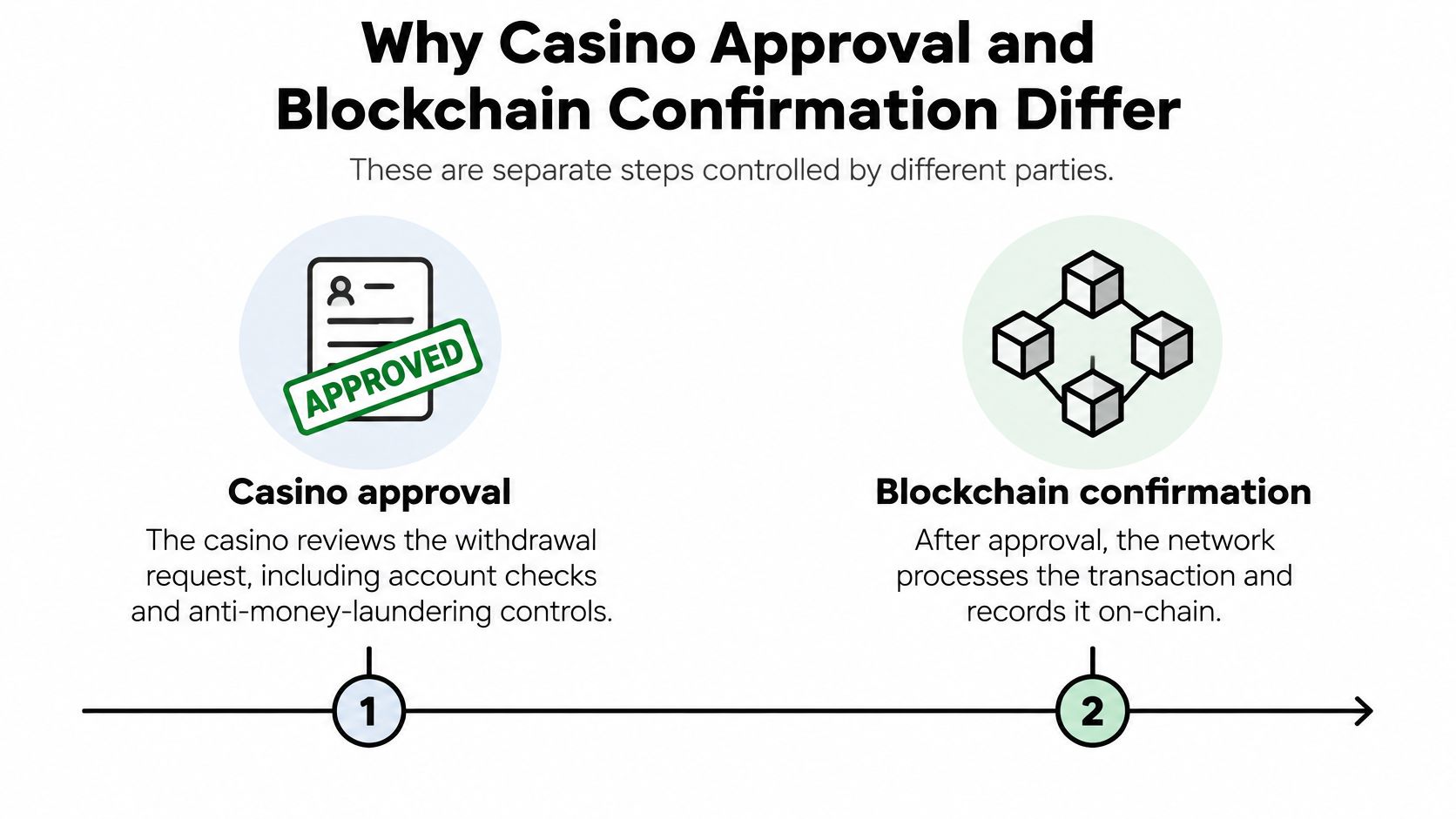
A withdrawal has **an operator-controlled approval process** and **a network-controlled transfer process**. A fast network says nothing about how long the request sat in the casino's queue.
The timeline makes that separation visible.
### Who controls each stage?
| Stage | Who controls it | What can hold it up |
|---|---|---|
| Request received | Casino account system | Request validation or account restrictions |
| Internal approval | Operator and relevant payment partners | Identity, transaction or anti-money-laundering review |
| Blockchain transfer | Sender broadcasts; network processes | Broadcast problems, congestion or transaction-fee settings |
| Receiving confirmations | Receiving wallet or service applies its crediting policy | Its required confirmation threshold |
The [UK Gambling Commission's age and ID verification guidance](https://www.gamblingcommission.gov.uk/public-and-players/guide/age-and-id-verification) says operators mustn't demand information at withdrawal that they could reasonably have requested earlier, although another legal obligation can require additional information at that point. That distinction matters when assessing whether an account review is justified.
> A pending request isn't the same as a pending blockchain transaction.
### What should you inspect when a withdrawal stalls?
Check the account's status wording, requested asset, destination address and network. Record when you submitted the request and whether the operator has supplied a transaction identifier.
If there's an identifier, inspect it using a block explorer for the correct network. If there isn't, ask whether the transfer has been broadcast rather than assuming the network is responsible.
Neither a prolonged approval nor a quick confirmation establishes the other stage's duration. Keep both timestamps when evaluating any advertised withdrawal claim.
## What Recourse You Have If a Crypto Casino Fails or Freezes Funds
Start with evidence you can preserve, not assumptions about what a wallet provider can recover. Your practical options turn on the legal entity, licence coverage, terms and location involved.
Keep these records somewhere you can access without logging into the casino:
- **Gameplay evidence:** Bet history, round identifiers and balance statements.
- **Payment evidence:** Deposit transaction identifier, asset and network.
- **Withdrawal evidence:** Request time, destination and status messages.
- **Correspondence:** Account notices and every document request with its stated reason.
### Which complaint route should you use?
Submit a formal complaint through the operator's published process, describing the disputed amount, event sequence and remedy you're seeking. Keep the complaint reference and copies of every response.
Next, approach the regulator named on the licence if its remit covers your circumstances. Follow any additional dispute-resolution route identified by the licence or terms, supplying the same organized evidence.
Our [fast-withdrawal casino guide](https://cryptogamerank.com/blog/fast-withdrawal-casino) can help you scrutinize payment claims, but speed claims aren't a substitute for an enforceable complaint route.
### Does a failed identity check permit confiscation?
The [UK Gambling Commission's identity-verification guidance](https://www.gamblingcommission.gov.uk/authorities/codes-of-practice/guide/page/identity-verification) says operators shouldn't remove deposit balances because identity or age verification failed, and permits a reasonable periodic account-maintenance charge only after **12 months** during which the customer couldn't verify identity. These are UK-specific protections, not universal terms.
An offshore crypto-only service may offer little formal recourse. A wallet provider can't reverse a completed blockchain transfer because the recipient refuses to cooperate.
**Recovery isn't guaranteed.** The outcome rests on the available authority, applicable terms and evidence you can produce.
## Responsible Play Controls to Check Before Depositing
A responsible-play page isn't a working safeguard. The meaningful test is whether you can activate a restriction yourself and see that it has taken effect before putting money at risk.
A [2025 review of the 50 most popular cryptocurrency gambling websites](https://www.scirp.org/journal/paperinformation?paperid=141140) found wager limits on **18%**, loss limits on **24%**, cooling-off periods on **66%** and self-exclusion on **82%**; cooling-off and self-exclusion often required support contact, and none of the responsible-gambling pages addressed cryptocurrency-specific risks.
### Which controls are actually usable?
**Responsible-play controls on reviewed crypto casino sites**
| Control | Share of 50 reviewed sites offering it | Self-service or support needed? |
|---|---|---|
| Wager limit | 18% | Check account settings; self-service availability wasn't established |
| Loss limit | 24% | Check account settings; self-service availability wasn't established |
| Cooling-off period | 66% | Often needs contacting customer support |
| Self-exclusion | 82% | Often needs contacting customer support |
A **wager limit** caps stakes, while a **loss limit** caps net losses under the operator's calculation. A **cooling-off period** pauses play for a defined interval; **self-exclusion** blocks access for a longer period under the scheme's terms.
Don't confuse a session reminder with a hard stop. A notification can be dismissed, whereas an enforced restriction should prevent the prohibited action.
### What changes when the money is cryptocurrency?
An account-level deposit limit governs what the casino accepts or credits. A restriction in a wallet app doesn't necessarily govern other wallets or the casino account, so establish exactly where enforcement happens.
Volatile assets can change local-currency value while you hold or gamble them. Irreversible transfers also make an impulsive deposit difficult to undo.
Before depositing, ask:
- **Can I activate it myself?** Find the control rather than relying on a policy statement.
- **When does it apply?** Read the confirmation and effective time.
- **What remains covered?** Check treatment of changed wallets, assets or country.
> **Stop signal:** Chasing losses or using money needed for essentials means it's time to stop, not increase the stake.
Seek help early from a local gambling-support service or healthcare professional. If you feel unable to stop, prioritize support and exclusion over further platform comparisons.
## Confirm the Basics Before You Deposit Anything
Use a pre-deposit routine rather than trying to resolve unanswered questions after funding an account. Our index is **18+ only**, and your location may impose a higher minimum age or prohibit participation.
1. **Confirm eligibility.** Check legal age and local gambling rules using the location checks outlined earlier.
2. **Verify accountability.** Identify the licence holder, regulator, complaint body and restricted countries.
3. **Read verification terms.** Establish required documents and when they may be requested.
4. **Match payment details.** Confirm the accepted asset, network and destination requirements.
5. **Inspect fairness evidence.** Find the inputs and method needed to reproduce an outcome.
6. **Record withdrawal conditions.** Separate approval requirements from network processing and read applicable fees.
7. **Activate limits.** Set deposit, loss and session restrictions before playing; don't assume they're enabled.
8. **Preserve records and support details.** Save the evidence and assistance contact you'll need.
If considering a promotion, use our [crypto casino bonus guide](https://cryptogamerank.com/blog/crypto-casino-bonus) to frame your questions, then read the operator's current wagering and withdrawal terms.
CryptoGameRank is an editorial index, not a gambling service; its ranking isn't a promise or recommendation. Third-party guides are starting points, not assurances of suitability. Research each platform independently and check the rules where you live before deciding.
---
Visit [CryptoGameRank](https://cryptogamerank.com) for a readable crypto-gaming index and individual platform overviews to support your independent research. Use those editorial pages to organize your comparison, then verify local eligibility, withdrawal conditions and usable responsible-play controls before considering any deposit.
18+ only. Gambling involves financial risk; local restrictions apply.