# Instant Win Games Explained: Formats, Odds and Risks
Learn how instant win games work, how they differ from other casino games, and which odds, payment and bonus terms matter before you play.
Author: CryptoGameRank Editorial
Published: 2026-11
Updated: 2026-11
Canonical: https://cryptogamerank.com/blog/instant-win-games
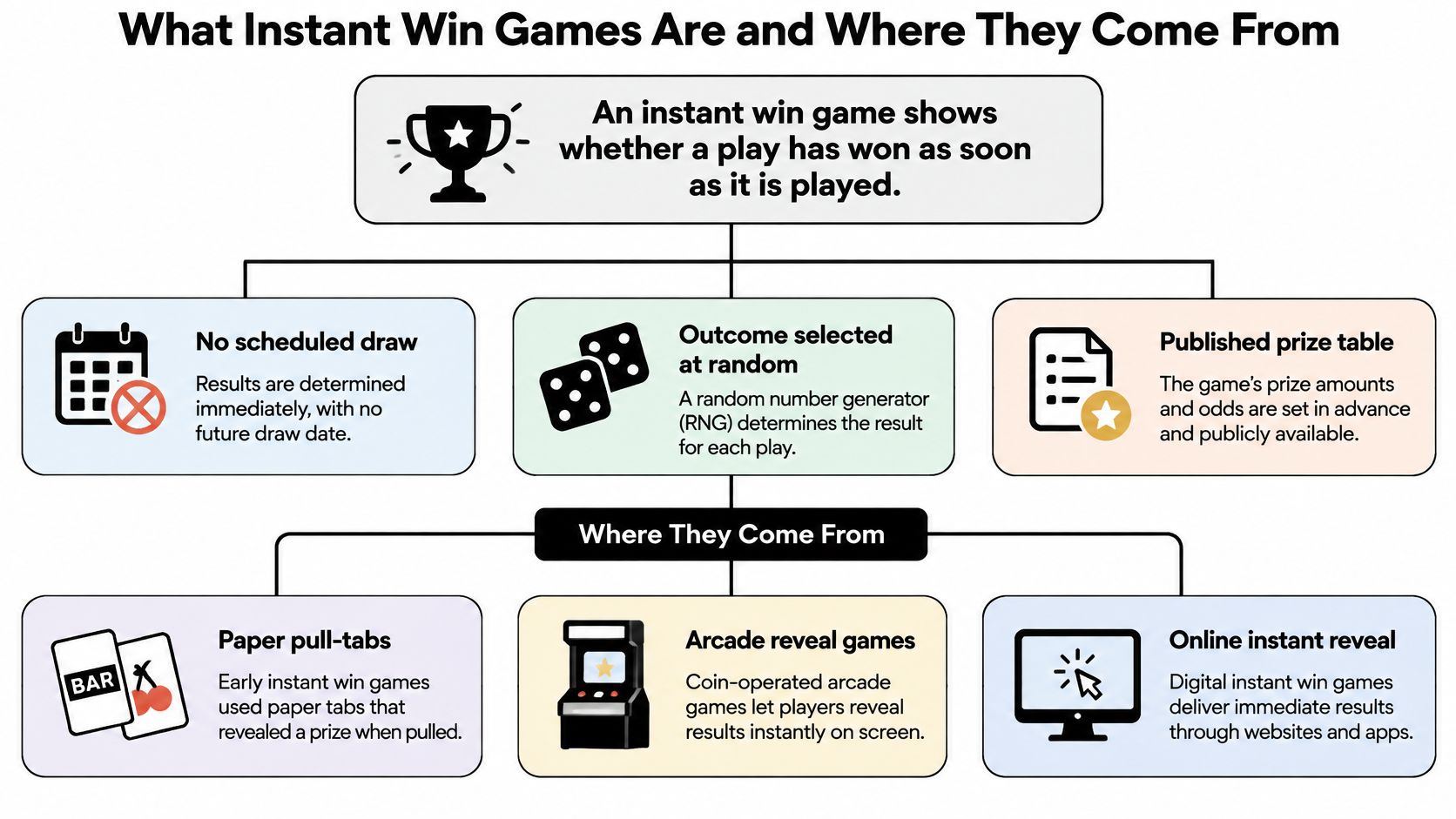
An instant win game reveals its result as soon as a wager is placed, with no scheduled draw, and the outcome is selected at random from a published prize table.
If the result is immediate, does that mean the game is simpler to assess, or that winnings are immediately withdrawable? Neither follows from the label. The rules behind the reveal, the payment process and any promotional conditions matter more than the animation.
This CryptoGameRank guide is for adults aged **18+**, subject to any higher local minimum age. It explains how to assess the product without treating speed, crypto payments or a ranking as an assurance of suitability.
## Table of Contents
- [What Instant Win Games Are and Where They Come From](#what-instant-win-games-are-and-where-they-come-from)
- [How did scratchcards become a wider game category?](#how-did-scratchcards-become-a-wider-game-category)
- [What do these formats share?](#what-do-these-formats-share)
- [How Instant Win Games Differ from Other Casino Games](#how-instant-win-games-differ-from-other-casino-games)
- [Does choosing a bet mean controlling the result?](#does-choosing-a-bet-mean-controlling-the-result)
- [How common is instant-win play?](#how-common-is-instant-win-play)
- [How Odds, RTP and Variance Shape Every Session](#how-odds-rtp-and-variance-shape-every-session)
- [How is RTP calculated?](#how-is-rtp-calculated)
- [What would a technical reviewer check?](#what-would-a-technical-reviewer-check)
- [Crypto Withdrawal Approval Versus Blockchain Confirmation](#crypto-withdrawal-approval-versus-blockchain-confirmation)
- [What risks remain after a winning result?](#what-risks-remain-after-a-winning-result)
- [Bonuses and Wagering Requirements Before You Play](#bonuses-and-wagering-requirements-before-you-play)
- [What does a wagering multiple actually mean?](#what-does-a-wagering-multiple-actually-mean)
- [Which conditions should you record?](#which-conditions-should-you-record)
- [Fairness Checks and Protections to Verify Before Playing](#fairness-checks-and-protections-to-verify-before-playing)
- [What should independent testing cover?](#what-should-independent-testing-cover)
- [Why does the legal product category matter?](#why-does-the-legal-product-category-matter)
- [How Session Speed and Screen Design Add Risk](#how-session-speed-and-screen-design-add-risk)
- [What should you inspect before the first reveal?](#what-should-you-inspect-before-the-first-reveal)
- [How should you use an editorial shortlist?](#how-should-you-use-an-editorial-shortlist)
## What Instant Win Games Are and Where They Come From
Think of an instant win game as opening a sealed envelope immediately rather than waiting for a letter to arrive on a scheduled day. You discover whether that play won without waiting for a shared draw.
The reveal isn't necessarily when the outcome is created. A physical ticket can already contain its result beneath a printed coating, while a digital game displays the outcome through software. Scratching, tapping or watching an animation makes the result visible, but doesn't give you control over it.
### How did scratchcards become a wider game category?
According to the [Play iLottery history of instant games](https://www.playilottery.com/instant-games/), instant-win lotteries became a major format in the **1970s**, and Scientific Games introduced an early computer-generated scratchcard through the Massachusetts Lottery in **1974**, with a **$10,000 top prize**. Massachusetts weekly lottery sales reportedly rose from approximately **$1 million to $2.7 million** after launch.
The same account reports **19% compound annual growth for Fast Play from 2019 through 2023**, with the format available in **26 jurisdictions by 2024**. Fast Play illustrates how the idea expanded beyond scratching a preprinted ticket: a retail terminal prints the ticket when it's purchased.
**Instant win game formats at a glance**
| Format | How the result appears | Typical setting | Main difference from a draw |
|---|---|---|---|
| Physical scratchcard | Scratch a printed panel | Retail lottery outlets | Result can be revealed immediately after purchase |
| Fast Play ticket | Printed on demand at a terminal | Lottery retail terminals | Printed and played in one transaction |
| Digital scratchcard | Revealed on screen | Licensed lottery or online platforms | Result appears after a digital reveal |
| Online instant win game | Revealed after a wager | Licensed online gambling sites | Wager and result occur in one short session |
| Casino-style reveal game | Result shown in one round | Online casinos, including crypto casinos | A short round replaces waiting for a scheduled draw |
The format families are illustrated below.
### What do these formats share?
Their traditional commercial model combines **low-cost entry, a visible prize structure and immediate resolution**. Low-cost entry describes the product model, not a guarantee that every available stake is small.
Check whether the prize table describes gross payouts or profit after deducting the stake. A reveal described as a win may still return less than the amount paid to play.
> **Practical rule:** Treat instant win as a description of how you discover the result, not a statement about safety, legal status or withdrawal rights.
## How Instant Win Games Differ from Other Casino Games
**Instant win games compared with other casino games**
| Game type | Player decisions per round | Result timing | Skill effect on expected return |
|---|---|---|---|
| Instant win game | None after the stake is placed | Revealed at once | None |
| Slot machine | None after the spin starts | After the spin completes | None |
| Blackjack | Hit, stand, double or split | Hand resolves after the relevant decisions | Basic strategy lowers the house edge |
| Roulette | Choice of bets before play | Result after each wheel spin | Comparable bets on the same wheel change volatility, not expected return |
| Live dealer table | Decisions set by the game rules | Shared dealer round | The chosen game's rules determine the skill effect |
The central distinction is **what you can decide after committing your stake**. A straightforward instant win game requires no further choice that changes the outcome. Blackjack asks you to make decisions during the hand, and those decisions affect expected results.
Slots share much of the instant-win structure: you choose a stake, begin a round and receive an outcome without an intervening strategic decision. A platform's menu categories may therefore overlap. A game listed under instant games might resemble a slot more closely than a lottery scratchcard.
### Does choosing a bet mean controlling the result?
Roulette separates **bet selection** from **outcome selection**. Choosing a broader bet changes the pattern of wins and losses, but it doesn't let you influence where the ball lands.
That comparison needs a boundary: special bets, alternative rules and different wheel layouts can have different expected returns. Don't assume every option offered at a roulette table has identical mathematics.
Live dealer describes presentation rather than a single game system. Watching a dealer doesn't tell you whether strategic decisions matter; the underlying blackjack, roulette or other rules do.
### How common is instant-win play?
A [summary of Britain's gambling participation surveys](https://igaming-times.com/learning/bingo-lottery-instant/three-verticals) reports that **7% of men and 6% of women** had played online instant-win games during the previous four weeks in **2023**. It also reports that **13% of adults** bought scratchcards during the previous four weeks in **2024**, making scratchcards Britain's third most common gambling activity.
Those figures demonstrate reach, not safety or favourable odds.
If you want few decisions within a round, instant formats fit that description. If you prefer making choices during play, distinguish meaningful strategic decisions from decorative interactions. Either way, check the individual game's rules rather than relying on its menu label.
## How Odds, RTP and Variance Shape Every Session
A shopkeeper's average takings over a year say nothing about one particular afternoon. **Return to player**, usually shortened to **RTP**, carries the same limitation: it describes a mathematical average across an enormous number of plays, not the shape of your next session.
Three terms do most of the work here. **Odds** describe the probability of a specific outcome. **RTP** combines every possible payout with its probability into a single expected return. **Variance** measures how widely real results scatter around that expectation.
Two instant win games can advertise the same RTP and feel completely different. One returns small amounts often; the other concentrates its theoretical return in rare large prizes. The average matches. The experience doesn't.
### How is RTP calculated?
The standard formulation multiplies each outcome's probability by its prize value and sums the results: **RTP = Σ pᵢvᵢ**. On a unit-stake basis, a game returning 95% keeps 5% as its theoretical house edge. That edge is a long-run property of the game's mathematics rather than a prediction about any individual session.
If prize values are stated in currency rather than stake multiples, divide the expected payout by the stake to obtain the return percentage.
**What the RTP figure means per units wagered**
The following figures are arithmetic illustrations calculated as total wagering multiplied by the house edge. They aren't observed player results or claims about an available game.
| Advertised RTP | Expected loss per 100 wagered | Expected loss per 1,000 wagered |
|---|---:|---:|
| 85% | 15 | 150 |
| 90% | 10 | 100 |
| 95% | 5 | 50 |
| 97% | 3 | 30 |
**Total wagering isn't the same as your deposit.** Reusing returned funds lets a single balance support repeated wagers, so expected cost applies to everything staked rather than only the amount transferred into the account.
> A long-run return percentage is neither a refund entitlement nor a target the game must deliver before you stop.
Short sessions sit far from the average. A hundred reveals can end well ahead, well behind or anywhere between, and a losing run creates no obligation for the game to compensate you.
### What would a technical reviewer check?
Reading an advertised percentage is only the first step. A thorough review examines three things:
1. **Compare the mathematics with outcomes.** Check the declared prize table and probability model against observed results, using an appropriate testing method.
2. **Match the display to the server.** Verify that the result shown to the player agrees with the authoritative game record.
3. **Recalculate after changes.** Alterations to probabilities, payouts or game logic require renewed mathematical validation.
A player can't derive the true RTP by watching a short sequence of reveals. Before playing, find the **game-specific RTP**, confirm the stake and payout table, and check whether an advertised percentage belongs to that game or is merely a platform-wide statement.
The same distinction applies when reading a [guide to real-money slots](https://cryptogamerank.com/blog/win-real-money-slots): a payout percentage describes expected cost across repeated wagering, not a route to profit.
## Crypto Withdrawal Approval Versus Blockchain Confirmation
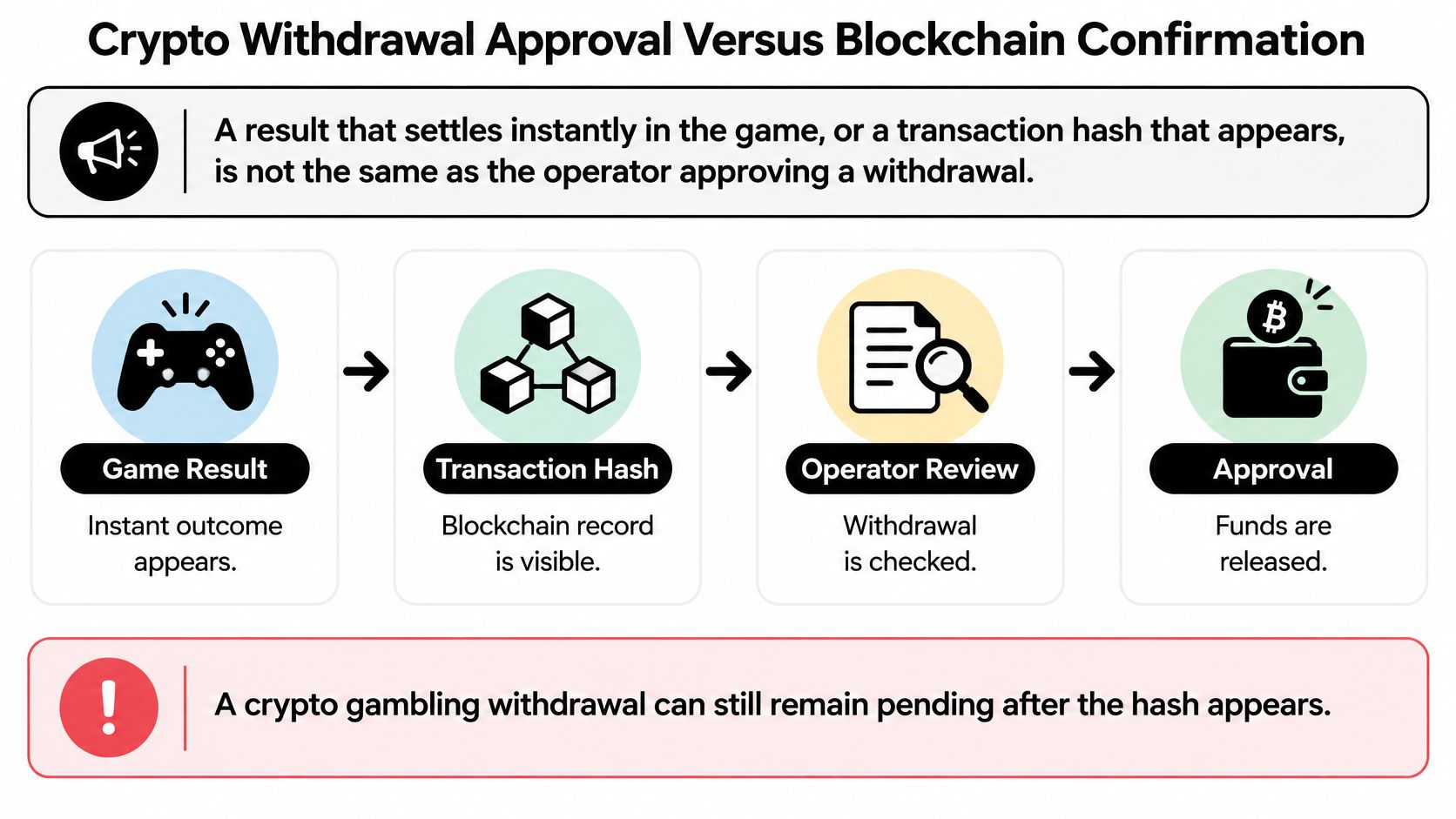
**An instant game result isn't an approved withdrawal.** A transaction hash also doesn't, by itself, establish that every operator-side review has been completed.
The operator first handles the withdrawal request under its terms. After approval, its payment process broadcasts the transfer, and the network can subsequently confirm ledger inclusion.
The illustration highlights the distinction, but the payment record and operator status must be checked separately.
**Stages of a crypto gambling payment**
| Stage | Who controls it | What it confirms | What can delay it |
|---|---|---|---|
| Operator review | The platform, under its own rules | Request approved or rejected | Identity, source-of-funds or anti-money-laundering checks |
| Broadcast | The platform's payment process | Payment submitted to the network | Internal processing queues |
| Blockchain confirmation | The network's validators or miners | Transaction included in the ledger | Network congestion and required confirmations |
Bitcoin confirmation timing isn't a fixed appointment. A broadcast transaction may be visible before confirmation, and the confirmation requirement should reflect the transfer's value and circumstances rather than a universal promise.
### What risks remain after a winning result?
The [UK Gambling Commission's crypto-asset guidance](https://www.gamblingcommission.gov.uk/licensees-and-businesses/guide/page/blockchain-technology-and-crypto-assets) identifies **price fluctuations against government-backed currencies** and **customer-identification difficulties** as additional risks. A Bitcoin-denominated prize can therefore change in fiat value before withdrawal completes.
The [FATF virtual-asset red-flag guidance](https://www.fatf-gafi.org/content/dam/fatf-gafi/brochures/Handout-Red-Flags-VA-Financial-Non-Financial.pdf) describes risk-based customer due diligence and includes online gambling among relevant money-laundering red-flag contexts. A wallet address is a payment destination, not a substitute for identity verification.
Before depositing:
- **Resolve eligibility and verification.** Check local permission, the operator's licence coverage and required identity documents.
- **Record value and costs.** Note the fiat value of deposits and prizes, and read the stated network, withdrawal and conversion charges.
- **Get the withdrawal conditions in writing.** Identify review expectations, document requirements and the policy that applies to your chosen asset.
For a visual accompaniment to payment terminology, the following video is available.
Use the [fast-withdrawal casino guide](https://cryptogamerank.com/blog/fast-withdrawal-casino) as a starting point for assessing those conditions, not as a promised processing time. Keep **game result, operator approval and blockchain confirmation** separate when interpreting any withdrawal claim.
## Bonuses and Wagering Requirements Before You Play
A bonus isn't unrestricted cash. **Promotional terms determine whether bonus-related funds become withdrawable**, even when the game has already displayed a winning result.
The [Behavioural Insights Team's April 2024 wagering-requirements study](https://www.bi.team/wp-content/uploads/2024/04/Results-Testing-the-impact-of-different-wagering-requirement-levels.pdf) found that bonus-plus-deposit offers were common, doubled the effective wagering requirement for most offers and dramatically reduced consumers' understanding of the obligation. Its proposal to cap bonus-only wagering at **1x** and ban bonus-plus-deposit requirements was a policy recommendation, not a statement of current law.
### What does a wagering multiple actually mean?
Consider a **hypothetical** promotion with a **30x requirement on a $100 bonus**. Multiplying the bonus by the requirement gives **$3,000 of qualifying wagering** before withdrawal can be considered under those conditions.
That calculation doesn't mean you'll retain the bonus while completing the wagering. Each qualifying wager can lose money, and the terms may exclude your chosen instant win game or count only part of its stake.
If the requirement applies to the deposit as well as the bonus, the calculation uses a larger base. Don't calculate the obligation from the headline bonus amount until you've identified exactly what the multiplier applies to.
> **Before claiming:** Write the obligation in ordinary language. If you can't explain what must be wagered and what can be withdrawn, leave the offer unclaimed.
### Which conditions should you record?
- **Qualifying amount.** Identify the deposit or other action needed to receive the promotion.
- **Wagering base and multiple.** Establish whether the requirement covers the bonus alone or bonus plus deposit.
- **Eligible games.** Find instant-game exclusions and contribution rules.
- **Maximum permitted bet.** Check restrictions that apply while wagering remains unfinished.
- **Expiry.** Record when the bonus and its wagering opportunity end.
- **Withdrawal restrictions.** Read any winnings cap, balance restrictions and consequences of cancelling the bonus.
Use a [crypto casino bonus guide](https://cryptogamerank.com/blog/crypto-casino-bonus) to understand the terminology, then read the actual offer's full terms before accepting it. Save the applicable version so you can distinguish the conditions you accepted from later promotional wording.
Treat any offer you can't describe using that checklist as unclear. Declining a bonus is a valid choice, and completing a wagering requirement doesn't guarantee that you'll finish with money to withdraw.
## Fairness Checks and Protections to Verify Before Playing
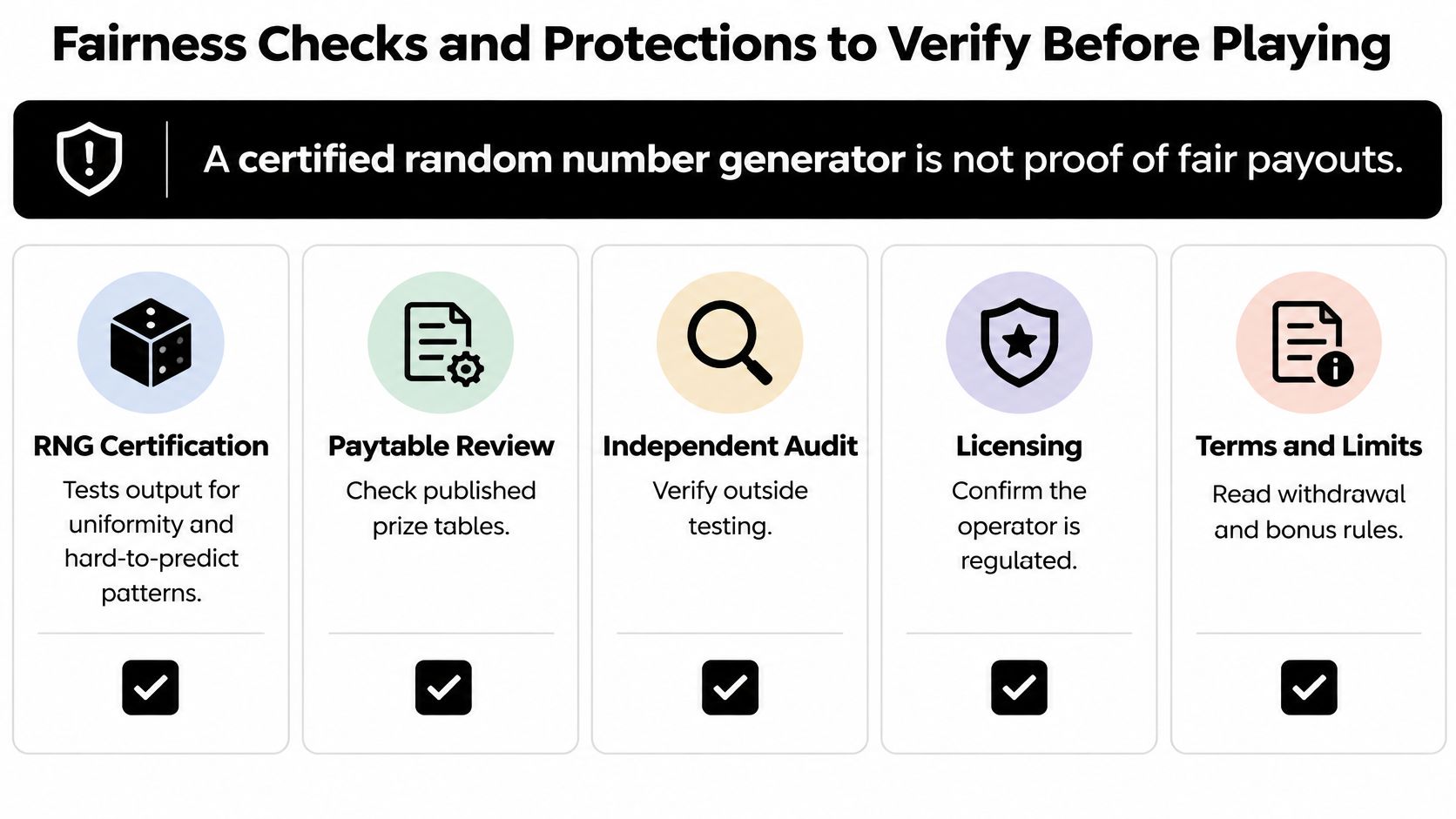
**A certified random number generator isn't proof of fair payouts.** Randomness and correct prize allocation are separate questions.
The [RNG certification explanation from Key2Law](https://key2law.com/en/news/what-games-and-platforms-are-required-to-have-rng-certification) distinguishes testing output for uniformity and unpredictable patterns from checking the game mathematics and prize table. A generator can pass its tests while an incorrectly implemented payout system still produces the wrong return.
### What should independent testing cover?
A reviewer needs to examine the complete path from random input to recorded payment:
- **Entropy and seeding.** How the system obtains and initializes randomness.
- **Statistical independence.** Whether results show inappropriate relationships.
- **Resistance to prediction.** Whether someone could anticipate outcomes.
- **Outcome-to-prize mapping.** Whether results receive the correct payouts.
- **Restart behaviour.** What happens after an interruption.
- **Transaction records.** Whether wagers, outcomes and credits can be reconciled.
- **Tamper protection.** How unauthorized changes are prevented or detected.
Request the **testing scope, laboratory identity, declared RTP and game version or change history**. Evidence that material modifications trigger re-testing matters more than a certification logo without an identifiable report.
The checklist below summarizes the areas to examine.
### Why does the legal product category matter?
Operator-hosted instant-win products and Interactive Instant Win Games on the National Lottery's licensed platform shouldn't automatically be treated as interchangeable. Licensing, age checks, self-exclusion, spending controls, credit-card restrictions, prize disclosures and responsible-gambling messages can differ.
The [Behavioural Insights Team's 2025 behavioural-risk audit](https://www.bi.team/wp-content/uploads/2025/10/Behavioural-risk-audit-of-instant-win-games-and-scratch-cards_BIT.pdf), discussing the DCMS prize-draw market study, reports that roughly **40% of online prize-draw operators offered instant-win products without additional player protections**. That finding concerns the studied prize-draw market, not every lottery or casino.
Identify who operates the product, who regulates it and whether local law treats it as gambling or a prize competition. Verify licence information against the relevant regulator's register rather than assuming an operator's badge establishes permission in your location.
On the player-facing pages, look for **age verification, self-exclusion, configurable spending limits, cooling-off tools, transparent wager history and a visible support route**. Check whether these controls apply to the specific product you're considering.
If you can't establish the operator's identity, applicable rules or meaningful safeguards, don't deposit. A crypto payment option doesn't replace any of those checks, and local eligibility requirements still apply.
## How Session Speed and Screen Design Add Risk
The next decision can arrive before you've considered the previous loss. **Session speed is a separate risk from the printed odds**, particularly when replay requires little deliberate action.
A [PLOS ONE study of online gambling behaviour](https://journals.plos.org/plosone/article/file?type=printable&id=10.1371/journal.pone.0273359) found that players increased stakes more after wins than losses, while responding more quickly after losses. The authors described these patterns as win-chasing in stake size and loss-chasing in speed.
### What should you inspect before the first reveal?
- **Replay defaults.** Check whether another wager requires a fresh, deliberate choice.
- **Exit controls.** Make sure you can leave without an interface blocking the action.
- **Stopping friction.** Notice unnecessary extra steps before pausing or ending play.
- **Stake prompts.** Ignore messages encouraging you to increase the wager after a result.
- **Withdrawal usability.** Assess the cashout process independently of the instant reveal.
A 2025 scoping review summarized by GREO_Research%20Snapshot_Dark%20patterns%20in%20online%20gambling_final.pdf) identified **16 studies** addressing dark patterns, including interface interference, forced action, obstruction, social engineering and withdrawal friction. It also noted limited behavioural evidence because researchers rarely receive operators' proprietary data.
These findings don't establish that every instant game causes harm. They do justify assessing the mobile journey from entry and deposit through repeated play, rather than examining the prize table alone. Interface features can affect your pace and spending decisions without changing the game's mathematical house edge.
### How should you use an editorial shortlist?
Our index orders its platforms as **01 Chancer, 02 Crashino, 03 Cristal Poker, 04 Beef, 05 Grail Bets, 06 Bitstarz, 07 1Win, 08 XS Bets, 09 Block Spin and 10 GG.Bet**. That order is an editorial starting point for independent research, not proof that a particular instant game suits you.
Our pages state that crypto gaming involves risk and may not be available in every location. Set affordable spending and time limits before playing, don't chase losses, and use cooling-off or self-exclusion if stopping becomes difficult. Local law, the applicable minimum age and licence coverage determine whether you're eligible.
---
CryptoGameRank provides an editorial shortlist and platform reviews to help adults begin independent research. Visit [CryptoGameRank](https://cryptogamerank.com) to compare the listed brands, then verify the specific instant game's rules, payment conditions and protections before deciding whether to participate.
18+ only. Gambling involves financial risk; local restrictions apply.