
no kyc casino
No KYC Casino Options: 10 Platforms to Compare in 2026
No KYC casino listings explained: what low-verification means, where checks still apply, and how to compare 10 crypto platforms by public terms.

There's a piece of advice repeated in nearly every crypto gambling thread: register with an email address, skip the ID upload, cash out whenever you like. It's half true, and the half that isn't true is the half that costs money.
"No KYC" is marketing shorthand for a low-friction front door. It isn't a legal status. Playing, depositing and withdrawing are three separate moments, and operator terms routinely reserve the right to ask for a passport, a selfie or a proof of address at the third one, long after the first two felt frictionless.
Two clocks get blurred in most lists of this kind. Casino approval time is how long an operator takes to clear a withdrawal internally. Blockchain confirmation time is how long the network takes to settle it. A site can approve you in a minute and still hold a payout pending documents, and a site can approve you instantly and still leave you waiting on block times.
This comparison is sorted by what each operator's public help pages and terms say about verification triggers, not by banner claims. Treat it as informational. Low-verification access isn't guaranteed anywhere, and whether a platform can legally serve you depends on its licence, your location and the gambling law where you live.
Table of Contents
- 1. CryptoGameRank
- 2. Rainbet
- 3. Gamdom
- 4. BitStarz
- 5. Stake
- 6. BC.Game
- 7. Duelbits
- 8. Rollbit
- 9. 7BitCasino
- 10. Cloudbet
- How each platform describes verification, payments, and location limits
- Using Low-Verification Casino Information Responsibly
1. CryptoGameRank
Start with the index itself. CryptoGameRank is an editorial starting point rather than a casino, and its shortlist, titled "The full ten", ranks ten crypto-gaming platforms from 01 to 10 in one readable view.
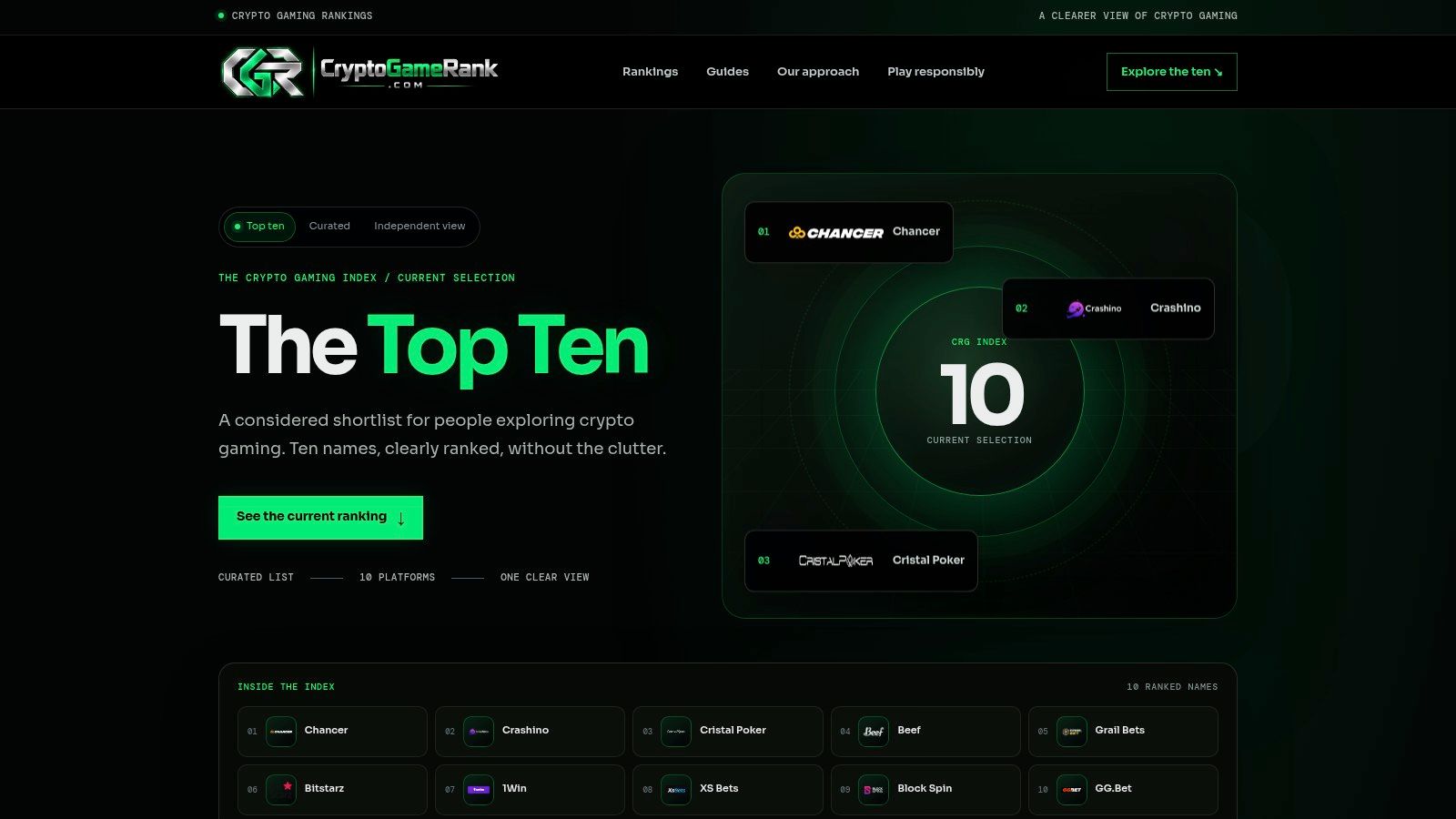
Rank and name lead every entry. The current order is Chancer, Crashino, Cristal Poker, Beef, Grail Bets, Bitstarz, 1Win, XS Bets, Block Spin and GG.Bet, with Chancer, Crashino and Cristal Poker marked as Featured at ranks 01, 02 and 03. Category labels sit alongside, covering slots, live casino and dealer games, instant and original games, sports betting and esports.
What the index is and isn't
Each entry carries a review link and a separate link to the operator's own site, which keeps the editorial page apart from the gambling service. The index is marked 18+ only and described as an editorial index, not a gambling service. Being ranked is not a promise or a recommendation, and readers are asked to research platforms and check the rules that apply where they live.
The reviews are public-source overviews built from the operator's official partner description and casino link. No accounts were opened, no deposits made, no payouts tested. That matters for a no-KYC casino comparison: nothing on an index page tells you an operator's withdrawal-time verification policy. Only the operator's own terms do.
Pros
- A fixed shortlist of ten: fewer names to sift than an open directory makes a first pass quicker.
- Scannable ordering: rank and name first, detail second, so you can see relative positions at a glance.
- Clear next steps: review links and external operator links sit beside each other rather than buried in menus.
- Category spread: casino games, live dealer, instant games, sports betting and esports all appear.
- Visible disclaimers: responsible-play guidance sits with the ranking rather than in a footer.
Cons
- Limited scope: ten entries won't cover every operator, and the selection won't suit every reader.
- Editorial, not personal: the ranking is a starting point, not a recommendation for your circumstances.
2. Rainbet
The clearest crypto-specific language in this set comes from Rainbet's help centre, which states that cryptocurrency transactions don't require KYC for play or withdrawals, then adds that the operator may request additional checks where activity looks suspicious. The terms separately reserve the right to ask for identity documents.
Read the trigger, not the headline. A statement that a payment method doesn't require KYC is not a statement that the account never will.
That gap is where most withdrawal disputes begin. FinCrime Central's review of tightened crypto casino AML compliance notes that many crypto casinos now request identity verification at withdrawals above roughly $1,000, while operators stay subject to AML controls even when they skip checks at registration. Rainbet also splits rules by payment rail, so crypto and Interac funding don't follow the same verification path.
Pros
- Crypto-specific guidance: the help centre addresses KYC directly rather than leaving it to the terms alone.
- Casino plus sportsbook: one account covers slots and betting markets.
- Payment-method clarity: the help pages explain why verification differs between rails.
Cons
- Checks remain discretionary: the operator can still request identity documents.
- Stalled access: a review can restrict wagering or withdrawals while it runs.
- Location-dependent: availability varies by country.
3. Gamdom
Gamdom takes the most relaxed line here. Its help centre says players can typically deposit, play and withdraw without a KYC request unless the operator asks for one, which is a smaller promise than it sounds. The same pages list withdrawals, promotions and regulatory reviews among the moments a check can appear, and a withdrawal can pause while documents are reviewed.
Where the monitoring actually happens
Pseudonymity isn't invisibility. A longitudinal analysis of decentralized Ethereum gambling applications followed 2,232,741 transactions from 24,234 unique blockchain addresses over 583 days and found the typical player spent about $110 equivalent across a median of six bets in one day. Public-chain records support that kind of pattern analysis without any identity document, which is why "no verification" rarely means "no scrutiny".
Pros
- Routine play without documents: official help pages say ordinary deposits, play and withdrawals may not trigger a check.
- Casino and sportsbook together: both live behind one login.
- In-house Originals: quick-play titles sit alongside third-party slots.
- Published triggers: the help centre names the situations that can prompt verification.
Cons
- Paused withdrawals: KYC can be requested and payouts held during the review.
- Promotion conditions: bonus eligibility may add its own requirements.
- Regional limits: location restrictions apply.
4. BitStarz
BitStarz's public pages say identity verification isn't needed to play, and the terms then carve out the space that lets the operator change that. They reserve the right to request KYC, including while a withdrawal is being processed, and state that failing to supply requested documents can prevent payment entirely. Read together, the offer is "no check unless asked", which sits somewhere between the fully discretionary posture of the widest terms and a genuine no-verification promise.
Why the paperwork outlives the session
The retention clause is the part players underestimate. Risk-based AML guidance covering virtual assets sets a de minimis threshold of USD/EUR 1,000 for occasional virtual-asset transactions and says records and customer-due-diligence measures should generally be retained for at least five years, so transactions can be reconstructed for competent authorities. That guidance addresses virtual asset service providers rather than casinos directly, but it explains the incentive behind the clause. An operator that may need to account for past transactions has a reason to confirm who a player is before releasing funds.
Practical rule: when a check is requested, send clear, uncropped documents first time. A rejected utility bill delays a payout far longer than the original review.
Pros
- Play-first onboarding: the operator's pages say verification isn't needed to start playing.
- Detailed terms: verification conditions are published rather than implied.
- Several crypto payout routes: more than one asset to withdraw in.
Cons
- Withdrawal-time KYC: checks can be requested mid-cashout and can block payment.
- Bonus strings: wagering and eligibility rules apply to promotions.
- Restricted markets: the United States appears among listed restricted countries.
5. Stake
Stake's terms are the widest in this list. The operator reserves the right to request KYC at any time and to restrict services or withdrawals until identity is established. Crypto-friendly, yes. Verification-free, no.
That posture tracks where the money moves. Chainalysis's 2024 money-laundering analysis reported that illicit cryptocurrency addresses sent USD 22.2 billion to services in 2023, down from USD 31.5 billion in 2022, and recorded a rising share of illicit funds reaching gambling services, including a substantial increase in ransomware-linked transfers. None of that makes an individual player suspect. It explains why a large operator with a sportsbook and a casino keeps discretionary checks rather than promising none.
Approval time versus confirmation time
Two clocks run on every cashout. The first is internal: an operator clears the request, runs any risk review and releases the payment. The second is the chain: the transaction confirms and reaches your wallet. Documents requested during clock one can add hours or days, and no amount of network speed fixes that.
Pros
- Broad catalogue: large casino lobby plus a full sportsbook.
- Published Originals: titles such as Plinko, Dice, Mines and Crash are listed with fairness-verification tools.
- Wide asset support: many cryptocurrencies accepted.
Cons
- Discretionary KYC: checks can be requested at any point.
- Restricted jurisdictions: the United States appears among many excluded countries.
- Account variation: payment options and access differ by location.
6. BC.Game
BC.Game publishes its licensing and verification information openly, and its terms put the trigger plainly: identity checks may be required, with withdrawals subject to account or KYC review. Registering without ID opens an account. It settles nothing about what happens at cashout.
Two obligations sit behind that posture. FATF's virtual-assets guidance designates USD/EUR 3,000 as the threshold at which casinos should identify and verify customers in financial transactions, and separately requires action where money laundering is suspected or previously collected identification data looks doubtful. That figure triggers identification for financial transactions at or above the level, separate from the suspicion-based checks described above, and it does not mean withdrawals below it go unchecked. National law, licence conditions and the operator's own risk assessment can move checks lower or earlier.
Pros
- Wide selection: casino games and sports betting under one account.
- Many crypto assets: a broad wallet for deposits and withdrawals.
- In-house games: Originals with published provably fair claims.
- Disclosed licensing: verification and licensing information is published.
Cons
- Verification at withdrawal: checks may be required when cashing out.
- Variable conditions: asset availability and transaction terms change.
- Country rules: restricted-market terms need checking before you register.
7. Duelbits
Duelbits publishes one of the more specific trigger lists in this ranking. Its AML and KYC guidance names four document categories a review can request: proof of identity, proof of address, payment-wallet evidence and source-of-funds material. Registration stays light until that point, with email, Google and Steam sign-in routes, so the gap between sign-up friction and later verification is wide and documented rather than hidden.
Two clocks run on every crypto withdrawal here. Casino-side approval is the operator's review window, where an AML trigger can pause access to a balance. Blockchain confirmation is network time after the operator releases funds, and no help page can shorten it.
Licensed-market rules offer one example of a stricter standard. UK Gambling Commission rules on age and ID verification require operators licensed in Great Britain to verify a customer's age and identity before gambling, normally name, address and date of birth ahead of play. They also prohibit making verification a withdrawal condition when the information could reasonably have been requested earlier. Those duties attach to the UK licence rather than to every crypto casino, but they show what a demanding regime looks like: checks at the door, not at the cashout screen.
Ask before you deposit: what documents can this operator request later, and what happens to my balance if I can't supply them? The answer lives in the AML section of the terms.
CryptoGameRank's Crashino review is a useful next stop if you're comparing fast-registration brands and want to see how terms are presented side by side.
Pros
- Multiple sign-up routes: email, Google or Steam registration.
- Document transparency: help pages list the document types that may be requested.
- Security options: two-factor authentication and account controls.
- Casino plus sportsbook: betting and casino games in one balance.
Cons
- Delayed funds: AML checks can hold access to a balance.
- Jurisdiction limits: restricted markets apply.
- Promotional terms: bonuses carry their own conditions.
8. Rollbit
Rollbit's help centre describes tiered verification, with the documentation required rising according to an account's circumstances. It also publishes a restricted-country list and explicitly excludes U.S. residents, which is more disclosure than many crypto operators offer. The practical reading is that sign-up friction stays low until account activity pushes you into a higher tier, at which point verification becomes a condition of continued play rather than an entry check.
Licensing deserves a check separate from the payment method. A no-KYC casino is not approved merely because it accepts cryptocurrency, so the licence claim needs to be matched in the regulator's public register and confirmed to cover your country. Where a platform mixes casino play with trading-style features, it also matters which product the licence covers, since the terms may not be shared across products.
Check the register, not the badge. Confirm the licence in the regulator's public list before depositing, and confirm it applies where you live.
Pros
- Several products: casino play plus crypto-related features in one login.
- Documented tiers: help pages explain how verification levels work.
- Published exclusions: a restricted-country list is available to read.
Cons
- Higher tiers mean KYC: more documentation can be required as an account grows.
- U.S. exclusion: residents are explicitly excluded.
- Different rules by product: gambling and non-gambling features may not share terms.
9. 7BitCasino
7BitCasino is a slots-first operator with crypto payment options and frequent bonuses. Its terms say it may request identity and residence documents for verification, including in connection with no-deposit bonus withdrawals, so the bonus route is often where checks appear first.

Low-friction onboarding is a measurable quality, and the measurement isn't flattering. A content analysis of 40 cryptocurrency gambling operators found that none verified the identity of new users, 35% required only an email address or no personal information to register, and two permitted underage users. Those figures describe a design choice, not a safety feature. The absence of checks shifts the work onto you: confirm age rules, deposit limits and self-exclusion tools exist before the first deposit.
If you want to see how a featured operator presents its terms, CryptoGameRank's Chancer review is a reasonable comparison point.
Pros
- Casino focus: a straightforward slots catalogue without a sportsbook bolted on.
- Reviewable terms: bonus and verification conditions are published.
- Crypto payments: deposits and withdrawals in digital assets.
Cons
- Bonus-triggered KYC: checks often appear around no-deposit bonus withdrawals.
- Wagering and caps: bonus winnings carry conditions and limits.
- Wide exclusions: many countries are listed as excluded.
10. Cloudbet
Cloudbet is the weakest match for a strict no-verification search, and it earns its place here by admitting that up front. Its help centre states that users must provide their name and address before making a first deposit, and the terms reserve broad identity-check rights on top of that initial collection.
Two things follow. First, the trigger point sits earlier than on any other platform in this list: the data handover happens before money moves, rather than surfacing at the cashout screen. Second, "must provide" and "may verify" are different obligations. The name-and-address requirement is fixed, while further document checks remain discretionary under the terms. Because identity data changes hands at the door, any later check is an addition rather than a first request.
Disclosure matters because the direction of travel is one way. ComplyAdvantage's roundup of the biggest AML fines of 2025 found cryptocurrency businesses were the primary target of global AML fines, with crypto-related penalties exceeding $927 million in the first half of the year, while EU reforms are expanding customer-due-diligence obligations for gambling providers.
What that means for a comparison
A platform that discloses collection upfront is easier to assess than one whose terms stay silent. You can read the requirement, decide whether it is acceptable and budget for it before you deposit. The trade-off is clarity over anonymity.
For another ranked listing to weigh against this one, CryptoGameRank's XS Bets review sits at rank 08 in the same index.
Pros
- Explained collection: the help centre says why name and address are needed.
- Casino and sportsbook: both products in one account.
- Formal documentation: terms and privacy policy are published.
Cons
- Details before deposit: personal information is collected up front.
- Further checks possible: additional verification can follow.
- Not anonymous: poor fit for anyone seeking minimal identity disclosure.
How each platform describes verification, payments, and location limits
| Item | Verification Stance | Crypto Support | Location Limits | Main Caveat |
|---|---|---|---|---|
| CryptoGameRank | Editorial guide; not a gambling operator | Covers crypto-gaming platforms; its own payment support is not stated | Readers should check local requirements | Curated top ten is an editorial starting point, not a recommendation or guarantee |
| Rainbet | Crypto play and withdrawals typically do not require KYC; checks may still be requested | Cryptocurrency payments | Availability depends on location | Terms allow identity checks that may affect withdrawals |
| Gamdom | Routine play may not require KYC; verification can be requested | Crypto support | Location restrictions apply | Checks may pause withdrawals or affect promotions |
| BitStarz | KYC may be requested, including during withdrawals | Several cryptocurrencies; crypto withdrawals | United States is among restricted countries | Requested documents may be required to receive payment |
| Stake | KYC may be requested at any time | Many cryptocurrencies | United States and other jurisdictions are restricted | Services or withdrawals may be restricted pending verification |
| BC.Game | Identity or withdrawal checks may be required | Broad range of crypto assets | Check restricted-country rules before registering | Registration without ID does not guarantee no verification |
| Duelbits | Checks may request identity, address, wallet, or source-of-funds documents | Crypto support not specified | Restricted jurisdictions apply | AML reviews can delay access to funds |
| Rollbit | Tiered verification; additional documents may be required | Crypto-related features | U.S. residents and certain other locations are excluded | Verification rules may differ across features |
| 7BitCasino | Identity and residence documents may be requested | Crypto payment options | Many countries are excluded | Verification may apply, especially to bonus withdrawals |
| Cloudbet | Name and address required before first deposit; further checks may apply | Crypto-focused funding | Location limits not specified | Not suited to users seeking minimal identity disclosure |
Using Low-Verification Casino Information Responsibly
A shortlist is a research tool, not a permission slip. Work through this before you open an account anywhere.
- Confirm the rules where you live. Age limits, licensing and legality come from your jurisdiction, not from an operator's marketing. A licence valid in one market says nothing about another, and a VPN doesn't create eligibility.
- Read the verification and withdrawal clauses together. Note the date you checked them. Terms change, and a help-centre answer from last year can be wrong this month.
- Identify the trigger that applies to you. For most players it's a withdrawal above an undisclosed threshold, a bonus claim or a run of deposits that looks unusual to a risk engine.
- Separate approval from confirmation. When you plan a cashout, ask how long the operator's internal review takes and how long the chain takes. Only one of those is outside the operator's control.
- Check the regulator's register. Match the licence number, the legal entity and the permitted markets. If the entity named in the footer doesn't appear, stop.
A no-KYC casino listing is a starting point for independent research. It isn't an assurance of access, of payout, of solvency or of safety. The same features that make registration fast, such as no identity check and no address on file, also make a dispute harder to pursue if a withdrawal is frozen and the operator sits outside your regulator's reach.
Set your limits in advance, in money and in time. Decide what a session costs before you start, then stop when it's gone. Never chase losses by increasing stakes to recover a bad run. If gambling has stopped feeling like entertainment, step away and use the self-exclusion tools the operator offers, or contact a support service in your country.
CryptoGameRank brings a curated top ten into one readable view, so you can see which crypto-gaming platforms are listed and where they sit before you read a single set of terms. Use it alongside the verification clauses you check yourself, since our rankings are an editorial starting point, not tested endorsements or a recommendation to play. Visit CryptoGameRank to see the current shortlist, the featured entries and the responsible-play guidance that sits with it.