
win real money slots
Win Real Money Slots: Odds and Payouts Really Work
Win real money slots? Learn how RTP, volatility, random outcomes, ID checks and crypto deposits work, and why no slot guarantees a payout.
No real-money slot can be guaranteed to pay out. Each spin is generated independently, and a game's advertised return to player is a long-run average rather than a result for one session: even a nominal 96% RTP doesn't mean a player staking 100 units gets 96 units back before logging off.
That's an awkward fact to open with on a page about winning, and it explains why the machines are so widely misread. Slots aren't a slow-paying lottery bolted to a casino floor. They're the product that keeps the floor open. By the end of the 2000s the United States had more than 830,000 electronic gaming machines, and electronic gaming devices had climbed from generating about 40% of total U.S. casino revenue in 1970 to roughly 70% in 2010, according to Britannica's history of the slot machine.
Three things decide what happens to your money: the stake you choose, the numbers the game publishes, and the terms attached to any bonus. Each one is checkable before you deposit, and each is covered below.
Table of Contents
- What Winning Real Money Slots Actually Means
- The Four Slot Numbers That Shape Your Results
- How Random Outcomes Work Behind the Reels
- Why Volatility Shapes Your Session, Not Your Average
- Identity Checks and Location Rules for Real-Money Slots
- Crypto Deposits and Withdrawal Timelines Explained
- Confirm Your Limits Before Your Next Real-Money Spin
What Winning Real Money Slots Actually Means
Most players arrive with a working assumption that a win is something the machine decides to hand over, and that the skill lies in catching it at the right moment. Neither holds. A payout is an event produced by chance, and no amount of stake switching, machine changing or patient waiting makes one more likely on your next spin.
Three different things people call a win
- A single spin that pays. Symbols line up and the game credits your balance. This is the smallest unit of winning, and the one people mean when they say a machine is "paying."
- A feature or jackpot triggering. Free spins, a pick bonus, a progressive prize. The event is bigger, but it's still one random outcome among millions, not a reward for persistence.
- A session that ends with more than you deposited. This is the only definition that matters to your bank balance, and it's the one least discussed in marketing copy.
Those three get blended into a single word, which is where most confusion starts. A player can hit an exciting bonus round and still finish the session down, because the bonus paid less than the spins that led to it.
Think of a weather forecast. A 30% chance of rain describes what happens across many similar days. It doesn't tell you whether your particular picnic stays dry. A return-to-player figure works the same way: it describes an average across an enormous number of spins, not the outcome of the hundred spins you'll play.
Practical rule: Judge a session by what you were willing to spend on entertainment, not by whether the reels cooperated.
The design point underneath all of this is a house margin. Operators keep a slice of every wager over time, which is why short sessions can end either way while long ones drift toward the expected loss. That slice explains why slots anchor casino economics. A U.S. Congressional Research Service report found commercial casinos in South Dakota and Iowa took more than 90% of their revenue from slot machines, with Nevada slots representing over 60% of gambling revenue in 2015, as summarised in a review published in the Journal of Gambling Studies. The same review notes that slots were the predominant gambling activity among pathological gamblers receiving help in numerous countries, a finding worth holding alongside any plan to play regularly.
The Four Slot Numbers That Shape Your Results
A game's information screen usually offers four figures, and players tend to grab the first one and ignore the rest. That's how a 96% game ends up feeling like a con after one bad hour. Read them as a set.
| Metric | What It Measures | What It Does Not Tell You | How to Use It |
|---|---|---|---|
| RTP (return to player) | Long-run average share of wagers returned to players | The result of any single session | Compare with volatility, maximum win and bonus terms |
| Volatility | How uneven payouts are, from frequent small wins to rare large ones | How often a win will happen | Match the level to your bankroll and session length |
| Hit frequency | How often a spin pays anything | The size of the payouts | Read together with volatility |
| Maximum win | The largest payout the game can award relative to the stake | How likely that payout is | Judge whether the top prize fits your goals |
Why an RTP needs a million spins to settle
The UK Gambling Commission's feature article on RTP and volatility draws the distinction that matters. Compensated games are engineered to approach their target RTP over tens or hundreds of thousands of cycles, while fully random games may need approximately one million or more cycles for the average result to stabilise.
A few hundred spins is a rounding error against a million. Short-term outcomes diverge substantially from the displayed figure because variance and payout clustering dominate small samples, so the percentage on the screen describes a horizon you'll never reach in one evening.
There's a second trap. The Commission notes that a game's stated RTP should be verified against the stake configuration and bonus mode you're playing, because different paytables or features can produce materially different expected returns. The headline number in a review may not be the number attached to your spin size.
What to check on the game information screen
- Confirm the RTP and the stake it applies to. Some games publish different figures for different bet levels or bonus-buy modes.
- Read the volatility label. It tells you how lumpy the payouts are, not how often you'll win.
- Note the maximum win. A top prize expressed as a multiple of stake is a ceiling, not a target, and the odds of reaching it are usually buried in the paytable.
- Check the wagering terms if a bonus is attached. Playthrough requirements change what a payout is worth.
None of these numbers predicts a result. Together they tell you what kind of game you're buying into, which is the only decision you make.
How Random Outcomes Work Behind the Reels
The reels are a display, not the mechanism. Behind them, a pseudo-random number generator decides the outcome, and the animation exists to show you a result that has already been settled.
The diagram below traces the sequence from number generation to visible reels.
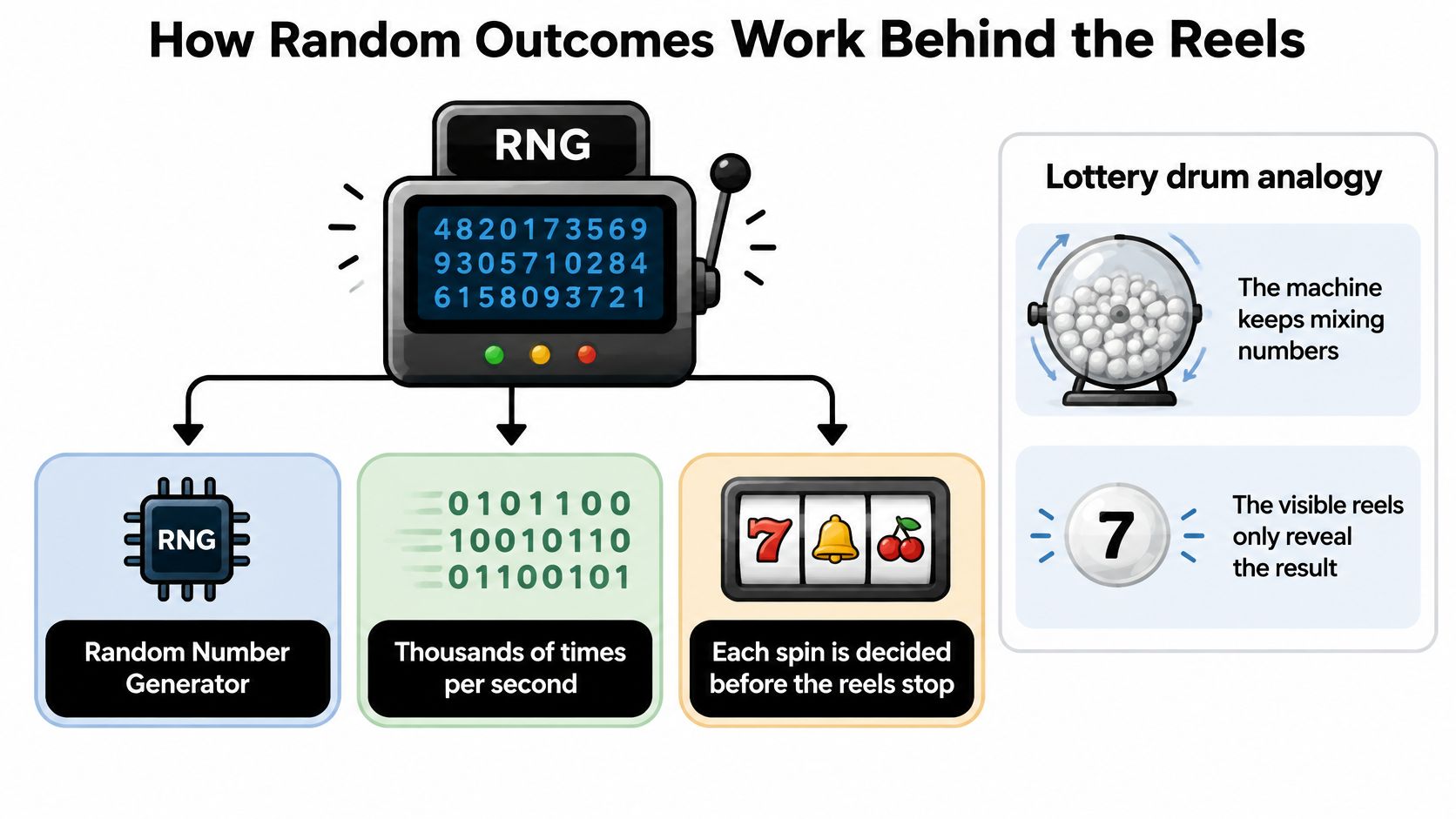
Picture a lottery drum that never stops turning. Numbers keep cycling whether or not anyone is watching, and pressing spin does nothing more than catch whichever value is passing at that instant. The previous spin is gone. Nothing accumulates.
Why a long dry spell doesn't build pressure
A peer-reviewed review of slot machine behaviour indexed on Europe PMC reports that modern slot machines can cycle through roughly 4.3 billion RNG values continuously at about 1,000 values per second. At that rate the machine runs its full range in a loop, and each outcome is drawn from the whole range regardless of what came before.
A machine that has just produced a run of losing spins is exactly as likely to pay on the next one as it was on the first. There's no pressure valve, no debt to be repaid, and no setting that shifts as the evening wears on. The same logic defeats the opposite belief, that a machine paying well is "hot" and worth chasing.
Near misses are presentation, not probability
Visual near misses, where two of three jackpot symbols land, can change how a result feels without changing the underlying probability of a win. The behavioural evidence is mixed. One controlled experiment found that a 30% near-miss condition produced greater persistence during extinction than 15% or 45% conditions, while later replication work failed to establish a reliable reinforcing effect. Neurobehavioural research did find that near misses were perceived as more win-like than ordinary losses, especially among problem gamblers.
- Treat near-miss animations as presentation. They're a graphic, not a forecast.
- Look for independent RNG testing and game approval in the game's own information panel rather than in promotional copy.
- Check the publication date of any behavioural research before you repeat its claim as settled fact.
An almost-win carries no information about the next spin. Treat every spin as the first one.
Why Volatility Shapes Your Session, Not Your Average
Return to player describes an average across an ocean of spins. Volatility is what the water does while you're in it, and that's the part you experience. Two games with identical headline figures can feel nothing alike.
The infographic below sets the two ideas side by side.
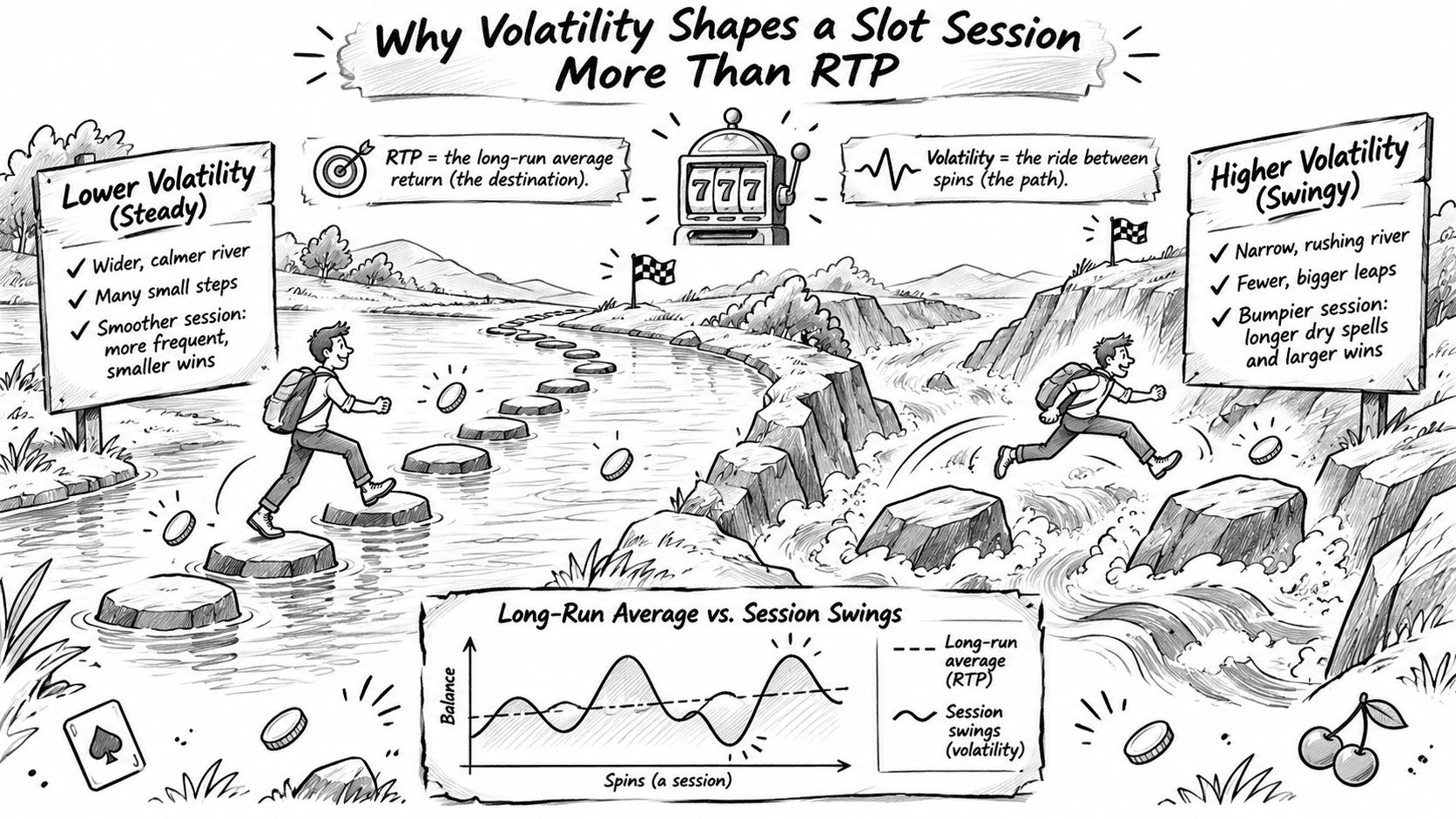
Think about crossing a river. A wide bridge with many small footholds is the low-volatility route: short, steady steps and no fall of any distance. A single rope over a gorge is the high-volatility route: long stretches of nothing, then a drop that ends the crossing. Both describe the same crossing on paper. Only one is manageable with a small bankroll.
Volatility is where session experience and long-run arithmetic split apart. A longitudinal study of approximately 2,600 UK online-slot players found that moving toward higher-volatility games was associated with shorter sessions and faster rates of loss, without materially changing aggregate losses on average, as reported in Playtech's analysis of volatility in online slots. The long-run cost barely moved. The experience changed a lot.
The other things that decide how fast a session moves
- Hit frequency controls how often something happens, which is what keeps most players in the seat, even when those small returns are below the stake.
- Bet size does more damage than game choice. Doubling the stake halves the number of spins your budget covers, so the same money is exposed to variance over half the sample.
- Spin speed and autoplay compress time. A fast session on autoplay can put a week's worth of spins through in an hour.
- Bonus features and jackpots pull in opposite directions: bonus rounds extend the time on screen, while progressive jackpot eligibility often demands a higher stake, which is where the money goes.
Take a 200-unit bankroll at 1 unit per spin on a 96% game, purely as arithmetic. Expected loss per spin is stake multiplied by one minus RTP, so 1 × 0.04 = 0.04 units. Across 200 spins, the average expected loss is about 8 units.
Those are averages, so a single session can land far from them in either direction. What the calculation gives you is the number of spins your budget buys and roughly what the entertainment costs. A high-volatility game can end the 200 units long before the spin count is reached, because the dry spells are the point of the design, not a fault.
The video below is a useful companion to that arithmetic.
Identity Checks and Location Rules for Real-Money Slots
In Great Britain, an operator has to know who you are before your first spin, not after your first win. That sequencing is the entire point of the rules below, and it catches out players who assume verification is something that only happens at cashout.
Online gambling operators in Great Britain must verify a customer's identity before allowing them to gamble, and the minimum information is the customer's name, address and date of birth, under rules described by the UK Gambling Commission's guidance on fairer and safer online gambling. Operators must also tell customers before they deposit which identity documents or other information may be required and when those checks could apply. The Commission adds that an operator shouldn't make a customer provide information as a condition of withdrawal if it could reasonably have requested that information earlier.
Paying in cryptocurrency removes none of this. A blockchain transfer is a payment method, not an identity check, and treating it as one is where players get caught out.
A blockchain confirmation proves the network accepted a transaction. It proves nothing about your eligibility to withdraw.
The Gambling Commission's guidance on identity verification sets out that operators shouldn't remove funds from a deposit balance merely because a player cannot verify their identity, though separate legal obligations such as anti-money-laundering rules can still require further information, and unresolved verification issues can affect account activity. Advertised payment convenience and the practical requirements for eligibility, account approval and cashing out are separate things.
The checks to run before you deposit
- Confirm your age. Real-money play is for adults 18 and over, and operators are required to check.
- Confirm the operator is licensed in your market. Search the regulator's public register for the operator's legal entity or licence number, because a badge graphic on the casino's own page proves nothing.
- Ask which documents will be requested and when. The Commission requires operators to state this before you deposit, so a site that stays vague has answered the question anyway.
- Read the withdrawal and verification terms before your first deposit, not after your first win.
Licensing and regional availability vary by country, and the question of whether crypto casinos are legal gets a different answer from one jurisdiction to the next, so verify the local requirements on your own regulator's site. Record the date you checked each rule, because licence, verification and withdrawal requirements change, and crypto gaming may not be available in every location.
Crypto Deposits and Withdrawal Timelines Explained
A parcel can reach the sorting centre in minutes and still sit there for two days waiting for a signature. Crypto payments work the same way, and confusing the two halves of the journey is the most common reason players think a site has lost their money.
Casino approval time and blockchain confirmation time are separate stages, as a breakdown of crypto casino deposit confirmations sets out. A transaction can reach the required number of blockchain confirmations without the casino immediately crediting your balance, because the operator may still need to match the transfer to your account and process it internally. Bitcoin blocks are produced roughly every ten minutes on average, but that average describes network block production, not the operator's review, identity checks or payout processing. No confirmation threshold is a guaranteed deposit or withdrawal speed.
| Stage | Who Controls It | What the Timing Means | What It Does Not Guarantee |
|---|---|---|---|
| Blockchain confirmations | The blockchain network | Bitcoin blocks average about 10 minutes each | Crediting of the casino balance |
| Casino matching and crediting | The operator | Not fixed; depends on the operator's processing | Any fixed deposit speed |
| Identity and withdrawal checks | The operator and legal obligations | Not fixed; may apply before a first withdrawal | Instant cashout |
The risks that don't appear in the marketing
Network congestion can stretch confirmation times. A wrong wallet address can lose funds outright, and crypto transfers are generally hard to reverse, which makes the operator's dispute process and complaint route more important than its payment logos. Compare the posted withdrawal conditions and limits, and treat any promised instant payout as a claim to verify rather than a fact. Our guide to fast withdrawal casinos explains what those terms usually cover.
Crypto acceptance gets read as a trust signal in both directions, and neither reading holds. Research on unregulated gambling markets found that only 5% of the world's top 100 betting operators offered cryptocurrency funding, compared with 43% of the illegal operators examined, up from roughly one-quarter of illegal operators in early 2024, according to a report on unregulated and unstoppable cryptocurrencies. Check the publication date before leaning on those figures.
What separates a careful operator from a careless one is licensing, identity controls, whether withdrawals can be reversed, the dispute process and sanctions exposure. Payment branding tells you none of it.
Confirm Your Limits Before Your Next Real-Money Spin
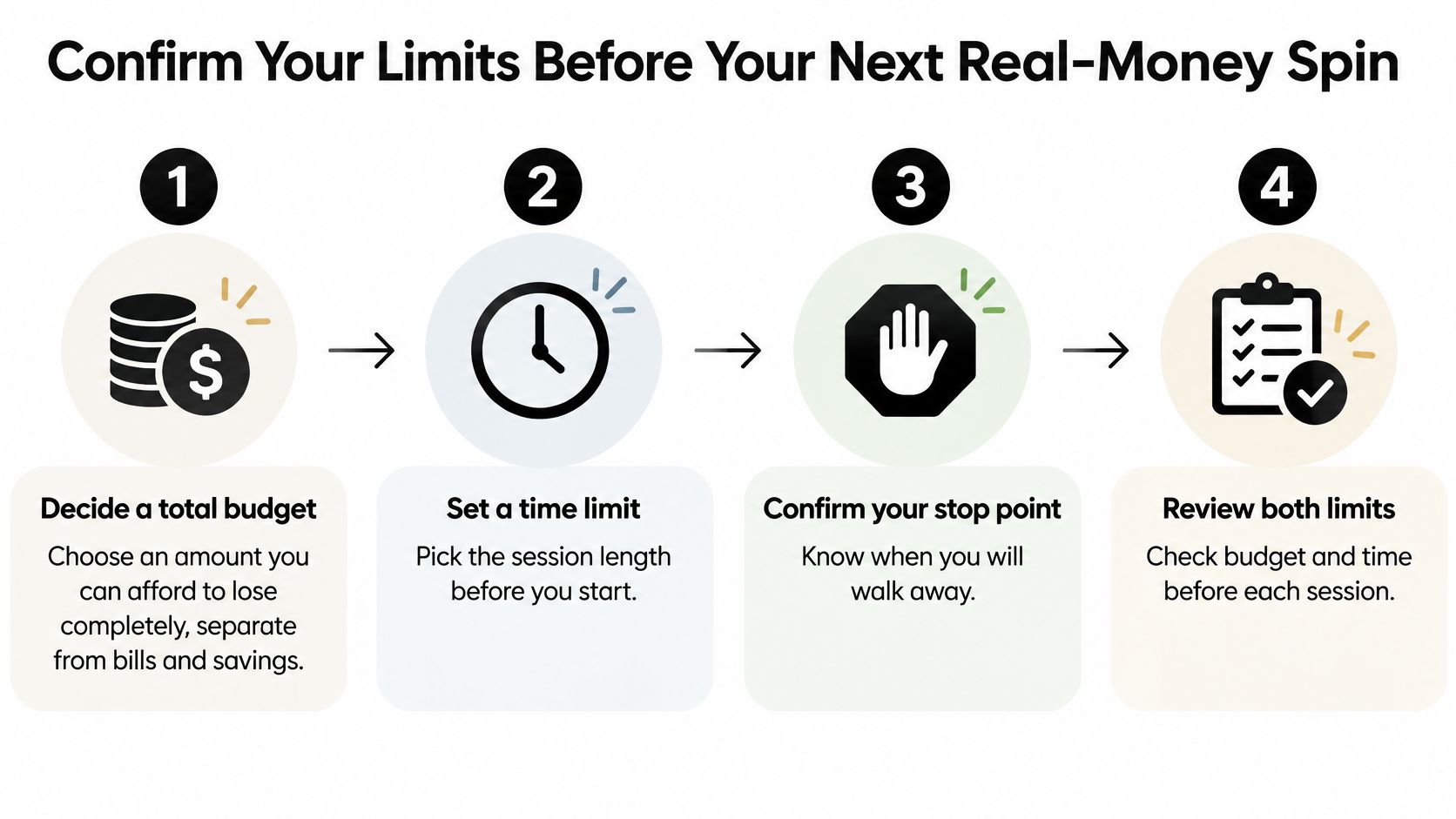
Limits set before a session are the only ones that hold during it. Once the reels are spinning, the same thinking that talked you into playing will talk you out of stopping. Run this routine once, at the screen, before any deposit clears.
- Decide a total budget you can lose completely. Keep it separate from bills, rent and savings, so the money has already left your real life.
- Set a time limit and a break schedule. A phone alarm is more reliable than your sense of how long you've been playing.
- Size the stake to the budget. Divide the budget by the stake to see how many spins it covers, then decide whether that's the session you want. A small stake on a high-volatility game can still burn through a budget fast, because long dry spells are part of the design.
- Write down a stop-loss and a stop-win. Knowing where you'll walk away after a good run matters as much as knowing where you'll stop after a bad one.
- Never raise your stake to recover a loss. Chasing changes the maths against you and turns a planned evening into an unplanned one.
- Turn on the operator's tools where they're offered. Deposit limits, session reminders and cool-off periods put your decisions from step one to four into the software itself, so the limit enforces itself instead of relying on willpower mid-session. Check which tools a given operator provides, since the range varies.
- Stop if it stops being entertainment and contact a confidential support service in your country.
Our index of ten crypto-gaming platforms is a public-source overview rather than a tested endorsement, and no accounts were opened, deposits made or payouts tested when compiling it. Use it as a starting point for research, then confirm current licence status, identity requirements and withdrawal terms on the regulator's register and the operator's own pages, noting the date of each check. Our responsible play guidance is deliberately short: set limits, never chase losses, and seek support if gambling stops feeling like entertainment.
If you want the wider picture before comparing names, our crypto casino overview is the sensible first stop. Crypto gaming involves risk, doesn't guarantee cashouts, and may not be available in every location.
CryptoGameRank publishes a ten-platform index where each entry carries a review link and a separate link to the operator's website, so you can compare crypto-gaming options without working through a sprawling directory first. Use it alongside the checks in this guide: open the review, read the operator's own terms, and confirm licensing and withdrawal conditions yourself before any deposit. Start with CryptoGameRank and treat the ranking as the beginning of your research rather than the end of it.