
crypto casinos legal
Are Crypto Casinos Legal? Licences, Location and Age Rules
Are crypto casinos legal? Not automatically. Legality depends on the operator's licence, your location and local rules, plus age limits and payment checks.

Crypto casinos are not automatically legal or illegal: legality depends on the operator's licence, the player's location and local gambling rules, including whether crypto payments are permitted. CryptoGameRank applies an 18+ minimum age to its index, but readers must also meet the legal gambling age where they live.
If a casino accepts your wallet and lets you open an account, what does that prove about its permission to serve you? Less than many players assume. A working deposit button answers a technical question, not a legal one.
Table of Contents
- Are Crypto Casinos Legal or Illegal?
- Do Crypto Payments or Offshore Licences Make a Casino Legal?
- How to Verify an Operator's Licence Step by Step
- Which Scenarios Are Risky
- What Age Limits and Harm Signals Apply to Crypto Gambling?
- Confirm Your Local Rules Before You Deposit
Are Crypto Casinos Legal or Illegal?
Crypto casinos are not automatically legal or illegal, because accepting Bitcoin, a stablecoin or another token doesn't create an exemption from gambling rules. The useful question is whether a particular operator can lawfully offer a particular gambling product to you, in your location, using that payment method.
Keep the following checks separate:
- Operator authorisation. Identify the legal business behind the site and the markets its gambling licence covers.
- Player location. Check whether local rules permit the gambling activity you want to use.
- Payment permission. Establish whether cryptocurrency can be used for that activity under the applicable rules.
A positive answer to one doesn't settle the others. Owning cryptocurrency legally, for example, doesn't establish that you can legally stake it at an online casino.
Why isn't website access enough?
A platform can be licensed in one country, lack authorisation in another and remain accessible in both. Its homepage loading successfully doesn't mean a regulator has approved it for your location.
The UK Gambling Commission's digital and virtual currency guidance treats digital-currency gambling as a licensing matter and expects operators to meet anti-money-laundering and social-responsibility obligations. These are regulatory conditions, not features a website can establish merely by displaying a wallet connection button.
Publication and access dates haven't been independently verified for the regulator pages cited here. Treat them as documents to check directly before acting, rather than as a dated assurance that any named operator currently complies.
Who is eligible to use these platforms?
Our editorial policy restricts the index to adults aged 18 or over. Under-18s must not use these platforms, and adults must still check whether their local minimum age is higher.
CryptoGameRank's pages state that crypto gaming involves risk and may not be available in every location. Our editorial starting point isn't a recommendation to gamble or an assurance of eligibility.
The legal test: The operator must be licensed for your market, the activity and payment method must be permitted where you live, and you must meet the applicable age requirement.
Do Crypto Payments or Offshore Licences Make a Casino Legal?
A casino chip is still part of a gambling transaction whether you buy it with cash or a token. Changing what you use to acquire the stake doesn't remove the underlying gambling activity from regulation.
The same distinction helps explain crypto payments.
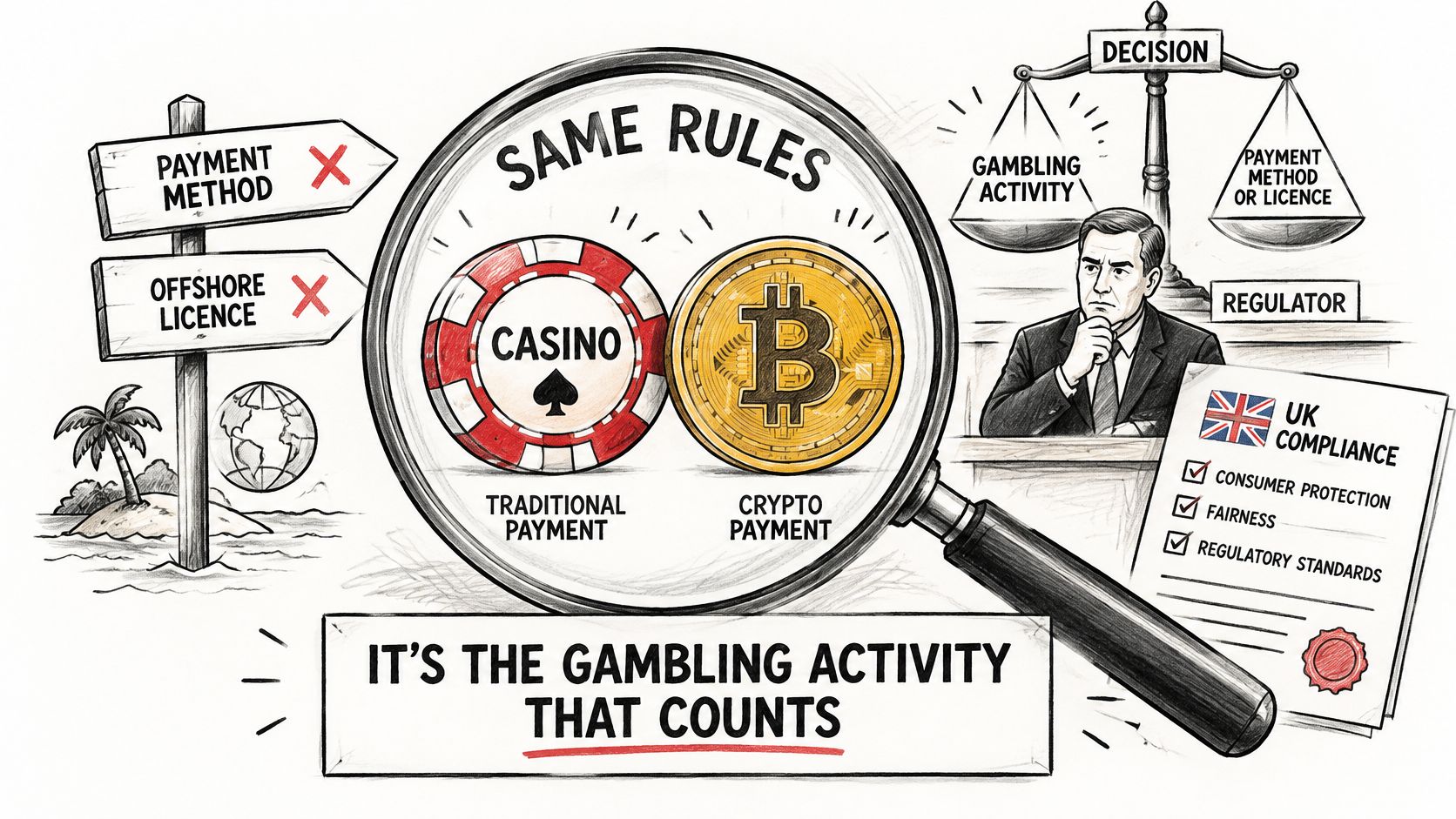
The UK Gambling Commission's guidance on digital and virtual currencies says gambling with virtual currencies requires a licence when those assets can be exchanged for cash or other items of value. It also states that remote gambling operators using British-based equipment fall within its regulatory scope.
That position doesn't amount to blanket approval for crypto casinos. It means the payment technology doesn't displace ordinary licensing requirements.
What does an offshore licence actually establish?
An offshore licence may establish that a regulator has authorised a business within a particular framework. It doesn't automatically establish permission to serve people in every country.
Company registration and gambling licensing are also different checks. Registration identifies an incorporated business; a gambling licence concerns permission to conduct specified gambling activities. Neither a registered address nor a certificate of incorporation substitutes for gambling authorisation.
| Claim on a casino website | What it doesn't establish |
|---|---|
| Registered company | Permission to offer remote casino games |
| Licensed offshore | Permission to serve your local market |
| Bitcoin accepted | Approval of that payment method for your circumstances |
| Blockchain-based games | Compliance with gambling and consumer-protection rules |
Say an operator advertises a foreign gambling licence and accepts crypto deposits. You still need to establish whether your country permits the activity and whether that operator has the authorisation your market requires.
If the operator lacks that permission, its foreign licence doesn't fill the gap. Nor does the fact that its payment processor successfully accepts your transfer.
The accompanying video provides another format for considering the topic.
Why should crypto appear in compliance disclosures?
Adding cryptocurrency isn't a website design change. The Gambling Commission's blockchain and cryptoasset guidance explains that licensed operators must report payment-method changes and review their anti-money-laundering risk assessment when introducing new payment methods.
Look for an explanation of how crypto is handled, rather than assuming a token logo answers the compliance question. Relevant disclosures should make the relationship between the operator, payment provider and customer understandable.
The Commission also identifies additional issues associated with digital currencies, including exchange-rate volatility, customer identification and establishing the source of funds. A familiar coin name doesn't eliminate those concerns.
For background on how these platforms work, our crypto casino guide can help distinguish the gambling service from its payment features. That distinction matters because a platform description isn't a legal clearance.
Use the two-check rule before depositing: confirm the operator's named licence, then confirm the rules where you live. A crypto deposit option creates a compliance question for the operator; it isn't proof that the site is lawful for you.
How to Verify an Operator's Licence Step by Step
Start with the legal operator, not the casino's branding. A trading name, a licence holder and a payment company may have different names, so you need to understand which entity provides the gambling service.
Use the regulator's official public register as your verification tool. A licence badge on the casino's own website is a claim to investigate, not independent confirmation.
What should you check in the register and terms?
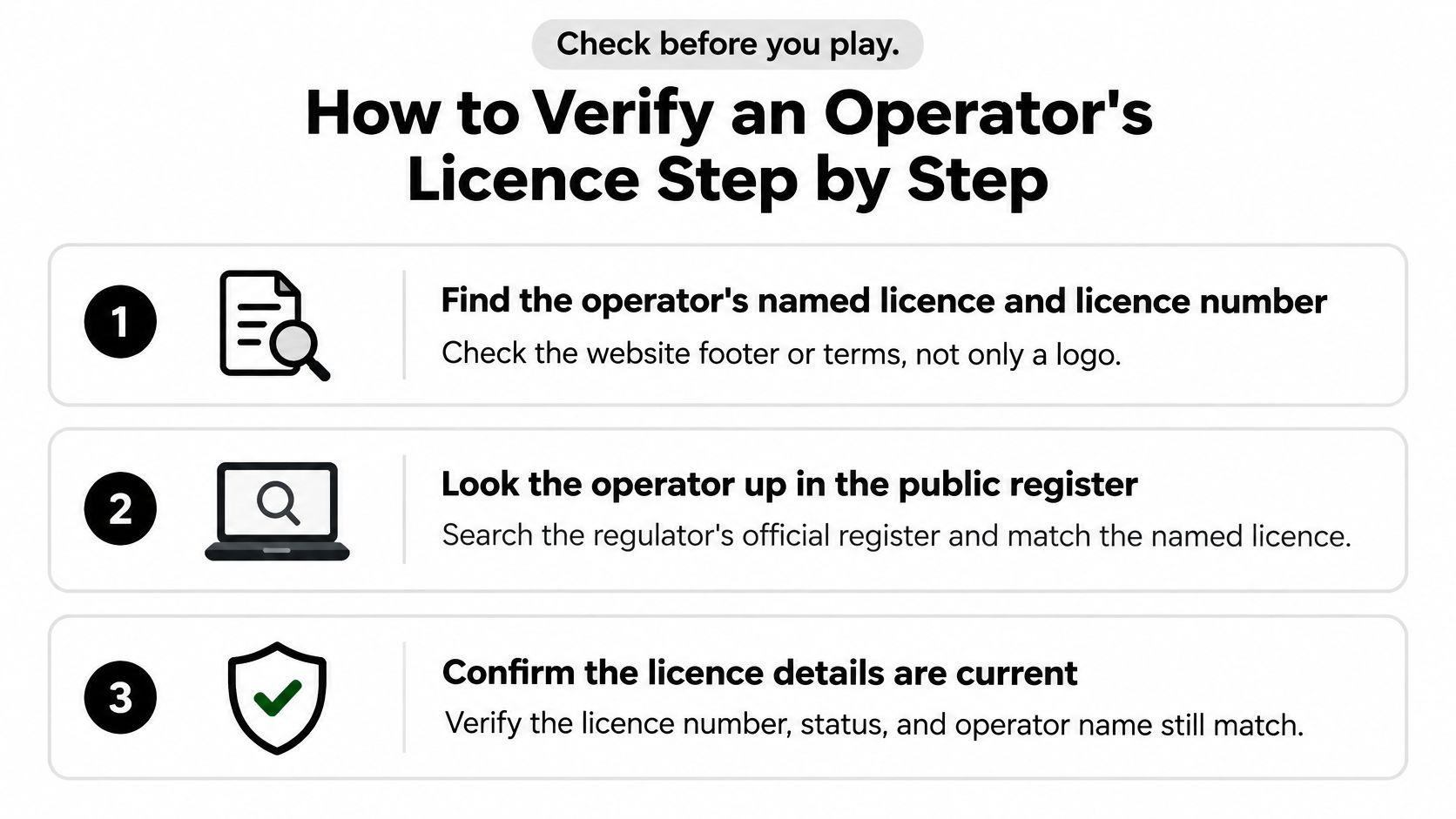
Find the named licence and licence number. Look in the website footer and terms for the legal operator, issuing regulator and licence reference. Don't stop at a regulator logo, because a logo alone doesn't let you match the business to an official record.
Search the issuing regulator's public register. Find the regulator independently and search for the operator or licence number. Compare the legal entity and current status, rather than accepting a footer statement without checking it.
Confirm the permitted gambling products. Check that the authorisation covers remote casino products if that's what you intend to use. Permission for sports betting or another activity shouldn't be treated as interchangeable.
Read the prohibited-territory terms. Search the terms for restricted countries, residence conditions and location requirements. Don't assume that account creation establishes eligibility if the contractual restrictions say otherwise.
Examine the crypto payment disclosures. Look for identity requirements, source-of-funds checks and the role of any payment processor. A deposit page listing tokens without explaining compliance or withdrawal conditions leaves important questions unanswered.
Match approved domains and check responsible-gambling tools. Where the register provides domain details, compare the exact website you're using and inspect the operator's deposit-limit and self-exclusion information. A similar brand name or copied design isn't enough to establish that you've reached the licensed service.
This visual checklist highlights the initial identity and register checks.
What should a credible crypto compliance explanation cover?
The UK Gambling Commission's cryptoasset risk guidance rates cryptoasset transactions as having medium likelihood and high impact, producing an overall high risk rating. It expects operators introducing crypto to consider source of funds, volatility, deposit limits, anti-money-laundering triggers, insolvency treatment and consumer disclosures.
For a player, that means checking who holds deposited funds, how withdrawals are reviewed and what happens if the operator becomes insolvent. Blockchain monitoring and sanctions screening also matter, even though customers may not see the operator's internal systems.
Watch for these warning signs:
- Missing licence details. No identifiable licence number or matching register entry.
- Unclear custody. No understandable explanation of who controls customer funds.
- Absent identity controls. Claims that verification can never be required.
- Incomplete payment terms. Crypto deposits are promoted, but withdrawal and compliance conditions are missing.
An unexplained mismatch is a reason to stop before sending funds, not a reason to test the platform with a deposit.
Which Scenarios Are Risky
The most useful comparison isn't crypto versus cash. It's whether your circumstances satisfy the operator's licensing conditions, local restrictions and payment requirements.
The positions below are starting points for investigation. They aren't statements that every country imposes identical duties on players and operators.
Crypto casino legality by situation
| Situation | Typical legal position | What to check |
|---|---|---|
| Operator licensed for your country | Generally permitted for adults who meet local rules | Licence number, product scope and approved domain |
| Operator licensed only offshore, your country bans online gambling | Operator not authorised to serve you; play carries legal and payment risk | Local regulator register and prohibited-territories clause |
| Unlicensed operator reachable from a licensing country | Typically unlawful where licensing is required, as the UK Gambling Commission states for Great Britain | Absence from regulator registers and official warnings |
| Licensed operator accepting crypto, withdrawal delayed | Licence does not guarantee payouts; identity and source-of-funds checks can apply | Withdrawal conditions, KYC requirements and custody terms |
| Player under 18 on any platform | Not permitted for the platforms covered by our adult-only editorial policy | Age-verification terms, identity requirements and local minimum age |
The final row reflects our adult-only policy, not a claim that every gambling product worldwide has an identical statutory age limit. Local requirements can be stricter.
What happens in real-world situations?
A British player sees a foreign licence. The site's foreign authorisation doesn't establish UK Gambling Commission authorisation. The player should verify the legal entity and domain against the relevant register rather than treating the foreign badge as equivalent permission.
A player deposits successfully but can't withdraw yet. The operator requests identity documents that weren't completed during registration. Successful payment processing didn't establish that the account had passed every compliance check, and the delay alone doesn't establish either fraud or lawful conduct.
The right response to a withdrawal query is to examine the stated requirements, retain transaction records and use the operator's documented complaint process where appropriate. Don't send additional gambling funds merely to test whether the account works.
Our fast-withdrawal casino guide addresses the separate question of payout processing. A speed claim shouldn't substitute for checking whether you're legally eligible to use the operator.
Does a VPN change your eligibility?
A VPN changes how an internet connection appears; it doesn't grant gambling authorisation. Using one to bypass location restrictions can also conflict with an operator's terms, leaving the original legal question unresolved.
In the United States, online gambling status is largely state-specific, rather than determined by a single federal crypto permission, as explained in CryptoVantage's US crypto-gambling overview. Check your own state's official gambling rules rather than relying on a nationwide yes-or-no answer.
Technical access is not a substitute for legal eligibility.
A foreign site's willingness to accept you doesn't settle your obligations. Equally, an operator's licensing breach shouldn't automatically be described as a particular criminal offence by the player without checking the applicable law.
These are typical positions, not legal advice. Confirm the rules that apply to your location and circumstances before participating.
What Age Limits and Harm Signals Apply to Crypto Gambling?
CryptoGameRank's index is 18+ only, and anyone younger must not use these platforms. Licensed operators still have to apply the age checks required in their market, and readers should confirm the legal minimum where they live rather than treating an editorial threshold as universal permission.
The index is an editorial publication, not a gambling service. An adult-only label also does not make gambling suitable for every adult.
Why do regulators scrutinise crypto gambling?
The UK Gambling Commission's digital technologies and anti-money-laundering publication reports that 6% of respondents used cryptocurrency as a gambling payment method in the previous 12 months, while 23% of respondents were experiencing severe gambling harm, defined as a Problem Gambling Severity Index score of 8 or more.
Those figures describe the respondents in the Commission's cited consumer research, not every crypto user. They do not show that crypto causes gambling harm. They do help explain why regulators treat crypto payments as a consumer-protection and compliance issue rather than a neutral deposit option.
The Commission also describes heightened money-laundering and terrorist-financing risks and says it is unlikely to license companies accepting cryptocurrency when they cannot adequately verify the source of funding. Its concern includes ensuring gambling businesses are not financed by criminal proceeds.
For Great Britain, the enforcement line is concrete: crypto casinos without its licence are illegal if accessible there. An offshore licence or international wording does not answer the three separate eligibility questions by itself: whether online gambling is allowed where you live, whether crypto is permitted as payment, and whether that operator is authorised for your market.
Why shouldn't you expect permanent anonymity?
Know Your Customer, usually shortened to KYC, refers to identity-verification procedures. Source-of-funds checks address a different question: where the money used for gambling came from.
A wallet address works more like a pseudonym than proof of identity, so connecting one does not settle who you are or whether the funds are legitimate. Do not choose a platform on the assumption that later document requests can be avoided.
Our guide to no-KYC casino terminology explains the label, but it must never be read as a promise of permanent exemption from verification.
When should you stop and seek support?
Watch behaviour, not just account balances:
- Chasing losses. Depositing again because you feel you must recover earlier losses.
- Using money for necessities. Gambling with funds intended for rent, food, bills or other commitments.
- Losing enjoyment. Continuing because of anxiety, pressure or habit rather than entertainment.
CryptoGameRank's responsible-play guidance recommends setting limits, never chasing losses and seeking support when gambling stops feeling like entertainment. If these warning signs apply, stop depositing, consider self-exclusion and contact a national gambling support service in your country.
You do not need to wait for a financial crisis to ask for help.
Confirm Your Local Rules Before You Deposit
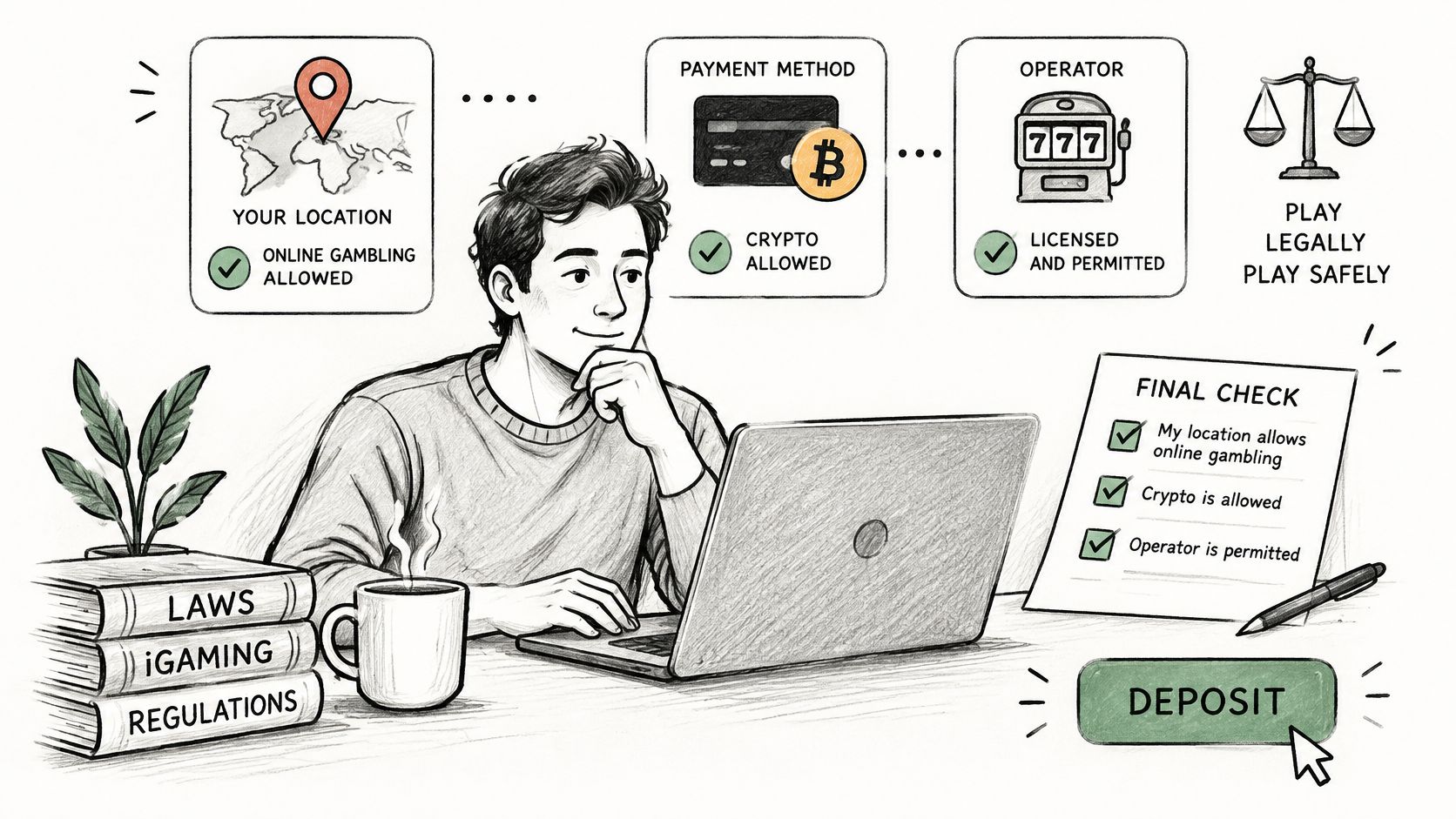
Before sending funds, resolve the questions that determine your eligibility: is online gambling permitted where you live, is crypto an allowed payment method, and is this specific operator authorised for your market? If you can't establish a clear answer, don't use a successful transfer as an experiment.
Check the legal entity, applicable terms and payment disclosures while your money is still in your own wallet. Save the relevant documents so you know which conditions you considered.
The final decision requires location, payment and licensing checks together.
What should you establish about cashing out?
Casino approval time and blockchain confirmation time describe different stages. The casino may review a withdrawal before releasing it; network confirmations concern the transaction after it has been broadcast.
A blockchain confirmation shows that a transaction was recorded on the network. It isn't regulatory approval, proof of account eligibility or a guarantee that the casino will approve a later withdrawal.
The distinction between gambling permission and payment compliance is discussed in DeucesCracked's crypto-gambling law overview. Identity and source-of-funds reviews can affect withdrawals even when a platform advertises crypto deposits.
Before depositing, establish:
- Withdrawal conditions. Read the approval process, restrictions and any stated timing.
- Required documents. Identify the identity and funding evidence the operator may request.
- Custody arrangements. Understand who controls deposited assets and the stated insolvency treatment.
- Payment compatibility. Match the supported token, network and destination requirements.
A stated payout time isn't a guarantee. If terms are unclear or contradictory, keep your funds out of the account.
How should you use an editorial ranking?
CryptoGameRank brings a curated top ten into one readable view, but our ranking isn't a promise or recommendation. We ask readers to research every platform independently and check the rules and requirements where they live.
Verify the licence, confirm your local rules, then decide whether to play at all. Choosing not to deposit is a valid outcome of careful research.
Visit CryptoGameRank for an editorial overview of crypto-gaming platforms and routes to individual reviews. Use it to organise your independent research, then verify each operator's authorisation, eligibility rules and payment conditions before considering a deposit.