
Curaçao gaming license
Curacao Gaming License: What It Does and Doesn't Mean
Learn what a Curacao gaming license signifies, how to verify a casino's license claims, and what it doesn't guarantee for players in your country.
What does a licensing badge on a crypto casino tell you about whether you can play there? Less than the badge might suggest.
A Curaçao gaming license is an authorization issued by the Curaçao Gaming Authority under the LOK. According to the regulator's historical account, that framework has been in force since 24 December 2024. The license confirms the operator sits under regulatory oversight. Whether players in a given country may legally use the site is a separate matter.
Three questions sit behind any badge: the operator's authorization, your own legal position where you live, and your ability to recover disputed funds. Each is worth checking independently, by looking at the company behind the site, the terms it applies, and the rules that apply to you locally. A credential deserves attention, but the final call rests with you.
Table of Contents
- What a Curaçao Gaming License Signifies Today
- How to Verify a Curaçao License Claim
- What a Curaçao License Does Not Guarantee
- KYC Checks and Blockchain Confirmations Are Different
- How to Escalate a Complaint or Withdrawal Dispute
- Apply the Checks Before You Deposit
What a Curaçao Gaming License Signifies Today
A Curaçao gaming license establishes a regulatory relationship between an authorized operator and the national authority responsible for supervising its online-gaming activities. It isn't, by itself, proof that every game is fair, every withdrawal will be paid, or every overseas player can legally participate.
Think of it as a certificate from a national regulator: meaningful under that regulator's rules and oversight, but not a passport that overrides another country's laws. The distinction matters because Curaçao has substantially changed how operators obtain authorization.
How did the licensing system change?
The regulator's historical account documents the milestones below, including the four government-issued master licenses through which operators historically obtained sublicenses.
Curaçao licensing milestones
| Date | Milestone | What it changed |
|---|---|---|
| 1993 | National Ordinance on Offshore Games of Hazard (NOOGH) adopted | Created the original offshore gaming framework |
| 1996 | First gaming licenses issued under NOOGH | Licensing began under the framework |
| 19 April 1999 | Gaming Control Board (GCB) established | Supervision of land-based and later online gaming |
| November 2023 | Direct-licensing process opened | Operators could apply without a master-license holder |
| 24 December 2024 | LOK in force; GCB becomes Curaçao Gaming Authority (CGA) | Direct online-gaming licensing and oversight by the CGA |
Under the former arrangement, an operator generally entered through a master-license holder rather than obtaining its own authorization directly from the regulator. That gave intermediaries an important gatekeeping role.
The reform changes who assesses and supervises the operator. For an operator, direct licensing creates a clearer relationship with the authority, alongside compliance obligations. For a player, it makes the identity and status of the actual licensee especially important.
Why do older credentials need closer attention?
Older casinos may still display sublicensing-era references. A historical credential can explain a business's background without establishing its present authorization.
The regulator's transition information identifies 30 April 2024 as the incentive-based deadline for existing sublicense holders seeking grandfathering treatment. Transitional certificates and orange seals also documented certain operators' ability to continue while applications were assessed.
That history makes a careful distinction necessary: an application, transitional permission, and an issued license aren't interchangeable. Check the current record rather than drawing a conclusion from the age or appearance of a badge.
How to Verify a Curaçao License Claim
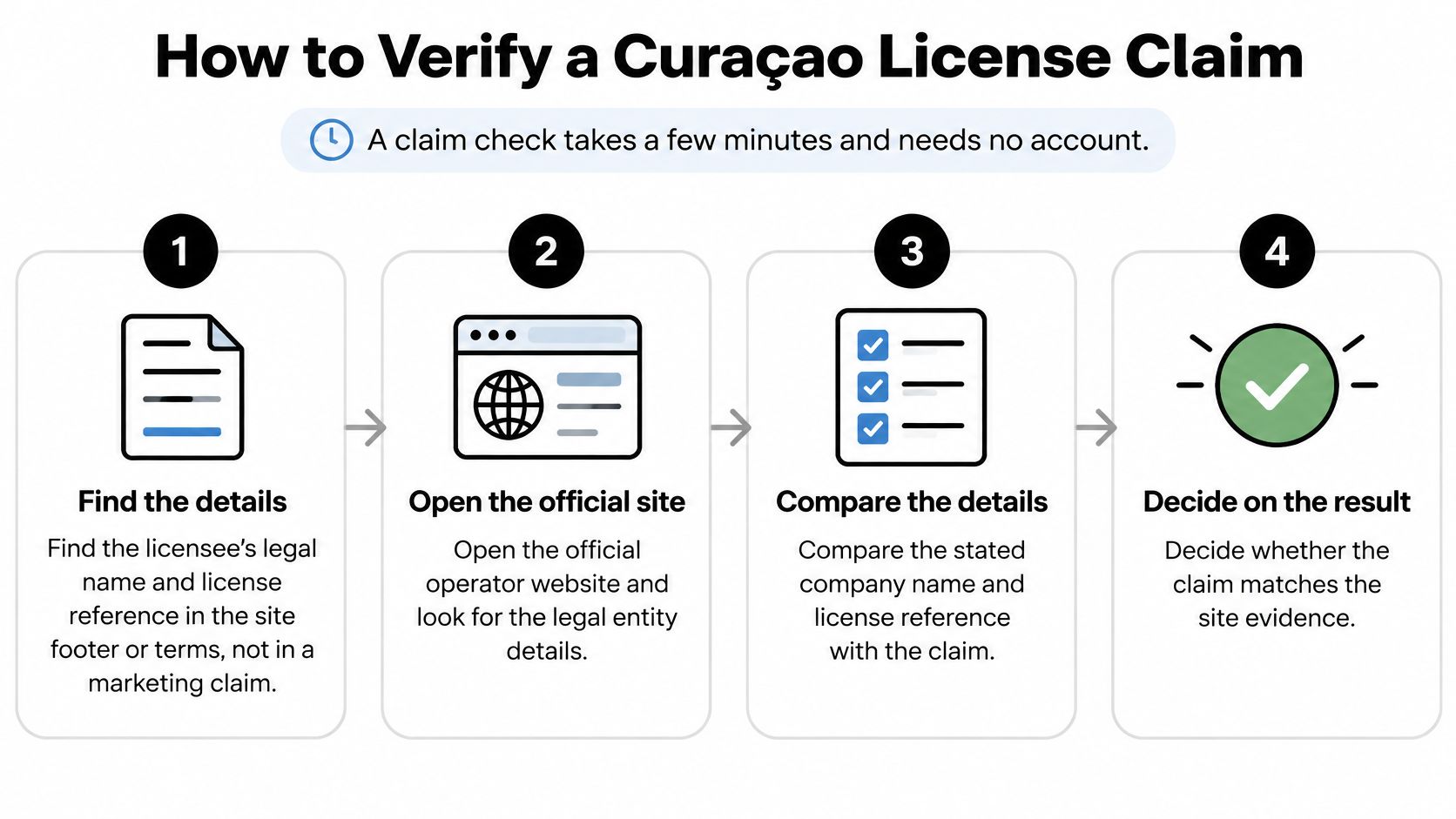
An initial claim check takes a few minutes and needs no account. You're checking public information, so there's no reason to deposit money or upload identity documents just to establish who operates a website.
The graphic summarizes the initial comparison. The checks beneath it go further by examining regulatory status and domain coverage.
Which details should you compare?
Find the legal name and license reference. Look in the footer, terms and conditions, or licensing page. A logo or badge image alone doesn't identify the authorization you need to check. The common mistake is treating a polished graphic as independent evidence.
Compare the company across the site. Check whether the licensee in the terms matches the company identified in the cashier or payment information. A separate payment processor may be involved, but the operator's role should remain understandable. Don't assume that every company named on the site holds the gaming license.
Check the authority's public information. Locate the claimed reference through the CGA's official resources and examine its current status and scope. Confirm that it covers online gaming rather than relying solely on a legacy sublicense or certificate of operation. If you can't establish the status, mark the claim as unresolved.
Match the domain. Compare the exact website you're using with the domain information associated with the authorization. Similar branding isn't enough: a copied badge or lookalike site can refer to a different business.
Read the operating conditions. Find country restrictions, identity-check requirements, withdrawal rules, and responsible-gaming controls. Don't mistake successful registration or an accessible cashier for confirmation that you're eligible to play.
Preserve the evidence. Save dated screenshots or PDFs showing the legal entity, license reference, status, and relevant domain. Include the official record, not just the casino's description of it.
What counts as a verified match?
A useful verification result is specific: matching company, matching reference, current active status, and appropriate scope. A license held by another company or covering a different domain doesn't establish the claim you're investigating.
If a seal opens a verification page, inspect where it takes you. A page hosted by the casino itself is still the casino's own statement, even if it resembles a regulator's certificate.
Practical rule: Record the date you checked the primary regulatory information, the licensee's legal name, and the reference number. Treat a claim without dated primary-source confirmation as unverified.
Public information may leave a question unanswered. That isn't automatically proof of wrongdoing, but it is a reason to pause rather than fill the gap with assumptions. Keep the distinction between verified, contradictory, and not established.
What a Curaçao License Does Not Guarantee
A Curaçao license isn't universal approval to accept players worldwide. The CGA's online-gaming information describes authorization for gaming in or from Curaçao, not a replacement for every destination market's legal requirements.
Operators still need to assess local law, geo-blocking, advertising restrictions, payment rules, tax exposure, and any requirement for national authorization. Players have a different question to resolve: whether participation is permitted where they live and whether that particular operator is authorized to serve them.
Stronger supervision and broader market access aren't the same thing. A regulator can improve oversight without making every licensed site lawful or equally accessible abroad.
What do common claims actually establish?
The CGA's published fee schedule lists a non-refundable EUR 4,592 application fee for a business-to-consumer online-gaming license. That is an operator application cost, not a player transaction charge or the total cost of running a casino.
Common license claims and what they establish
| Claim you may see | What the license signals | What it does not establish |
|---|---|---|
| Licensed in Curaçao | The operator holds an authorization from the CGA, if independently verified | Legal access for players in every country |
| Valid license badge | The regulator recognizes the operator, if the badge matches its official record | Fair games, guaranteed payouts, or fast withdrawals |
| No verification needed | The operator must run identity and AML procedures | The exact documents or review times |
| Low fees | The CGA application fee is an operator cost, EUR 4,592, non-refundable | Deposit, withdrawal, or bonus terms for players |
| Safe to play | Responsible-gaming tools and complaint procedures are required | Compensation or guaranteed recovery of funds |
Deposit fees, withdrawal charges, bonus conditions, and wagering requirements come from the operator's own terms. Read the applicable payment, currency, promotion, and country conditions rather than inferring them from regulatory fees.
For a bonus, check which bets count toward wagering, any withdrawal restrictions, and the conditions for cancellation. A licensing claim doesn't tell you whether an offer suits your intended play.
How should you check your own legal position?
Start with your country's gambling regulator or official government guidance. Where local authorization is required, look for the operator in that jurisdiction's register rather than substituting its offshore credential.
Our guide to whether crypto casinos are legal helps frame that separate jurisdictional question. Our pages also make clear that crypto gaming involves risk and may not be available in every location.
A functioning website, accepted cryptocurrency, or valid Curaçao credential doesn't settle your eligibility. Access is a technical fact; permission is a legal question.
KYC Checks and Blockchain Confirmations Are Different
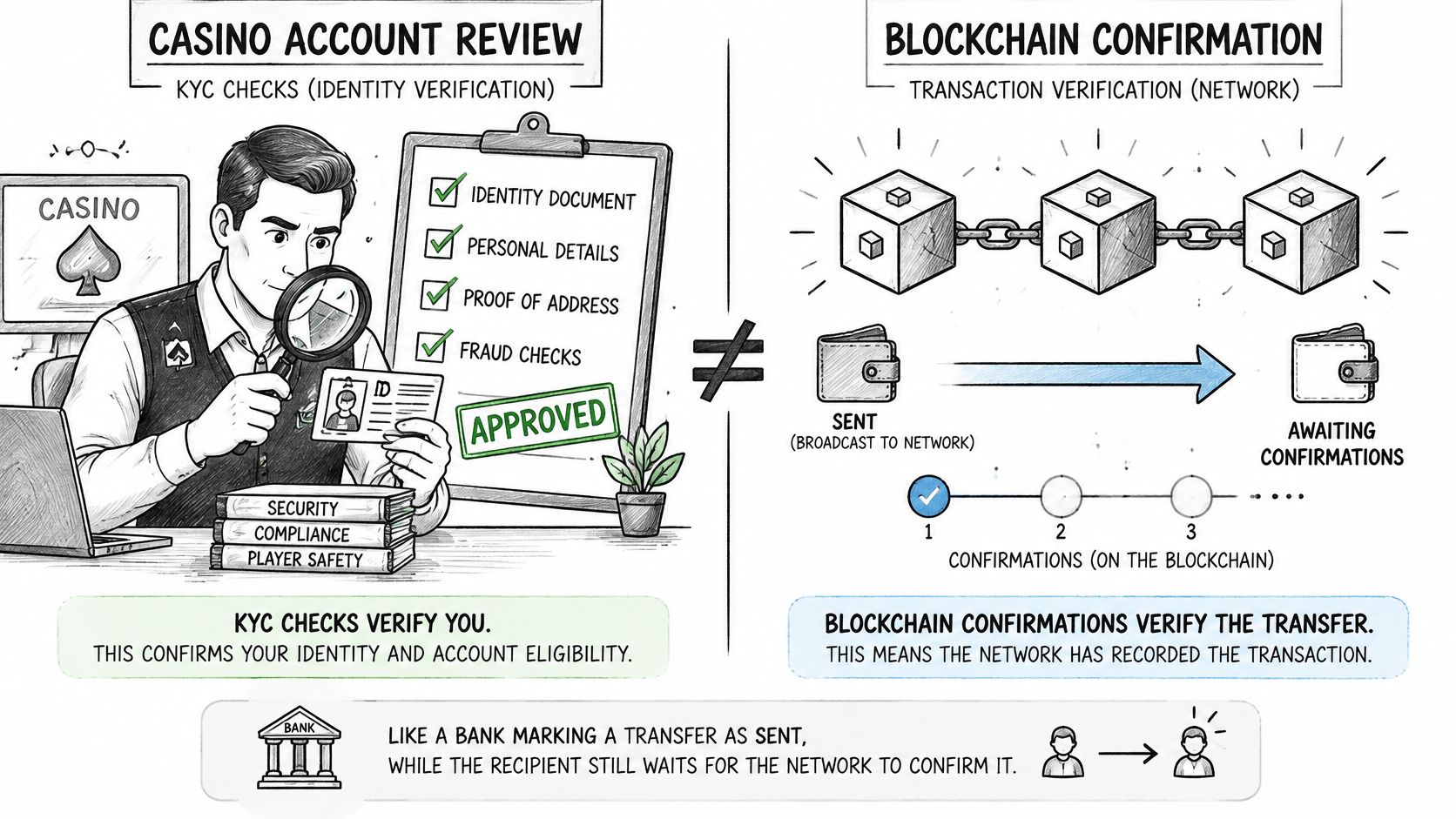
Casino approval and blockchain confirmation are separate processes. A bank may show a transfer as sent while the recipient's office still needs to approve how it is credited. A crypto casino can likewise recognize a transaction on the network while keeping an account action pending.
The distinction is easier to follow when the processes are shown separately.
Who controls each stage?
- Network confirmation: The cryptocurrency network processes the transaction. Confirmation requirements depend on the asset, network, wallet infrastructure, and operator or payment provider, not a universal Curaçao rule.
- Account crediting: The operator or payment provider reconciles the transfer with your casino balance. A confirmed transaction may still appear as pending internally.
- Identity review: The casino checks the documents and information needed for its compliance process. Network confirmation doesn't complete that review.
- Withdrawal approval and broadcast: The operator reviews the withdrawal request before sending a transaction. Only after broadcast can you track that outgoing transaction on-chain.
The CGA's AML guidance establishes customer identification and verification as compliance obligations. Operators may request identity and address documents before deposits, withdrawals, or continued play, and may restrict an account while checks are completed.
The precise documents, triggers, and processing times remain operator-specific. Our no-KYC casino guide provides context for evaluating that marketing phrase, but it shouldn't be read as a promise that verification won't occur.
The following video provides additional context alongside the distinction between operator checks and transaction processing.
Is an AML threshold a withdrawal limit?
The CGA's regulatory-scope guidance identifies a transaction valued at NAf 5,000 or more, or its foreign-currency equivalent, as an objective reporting indicator for casino, lottery, and internet-gambling providers. It isn't a guaranteed withdrawal allowance, payout deadline, or blockchain-confirmation requirement.
Ask the operator which stage is pending, which documents remain outstanding, and what review timeframe its policy states. For an outgoing payment, ask whether it has been broadcast and request the transaction ID. A blockchain explorer can establish network status, but it can't explain an internal compliance decision.
How to Escalate a Complaint or Withdrawal Dispute
The Curaçao Gaming Authority isn't a substitute court for every individual dispute. Reporting a problem may help regulatory supervision, but it doesn't guarantee compensation or an immediate payment order.
A withdrawal disagreement also needs a defined complaint, not just repeated chat messages. Identify what happened, which term or obligation you believe applies, and what resolution you're seeking.
What evidence should you preserve?
The escalation pathway separates the operator's complaint process from independent dispute resolution and regulatory reporting.
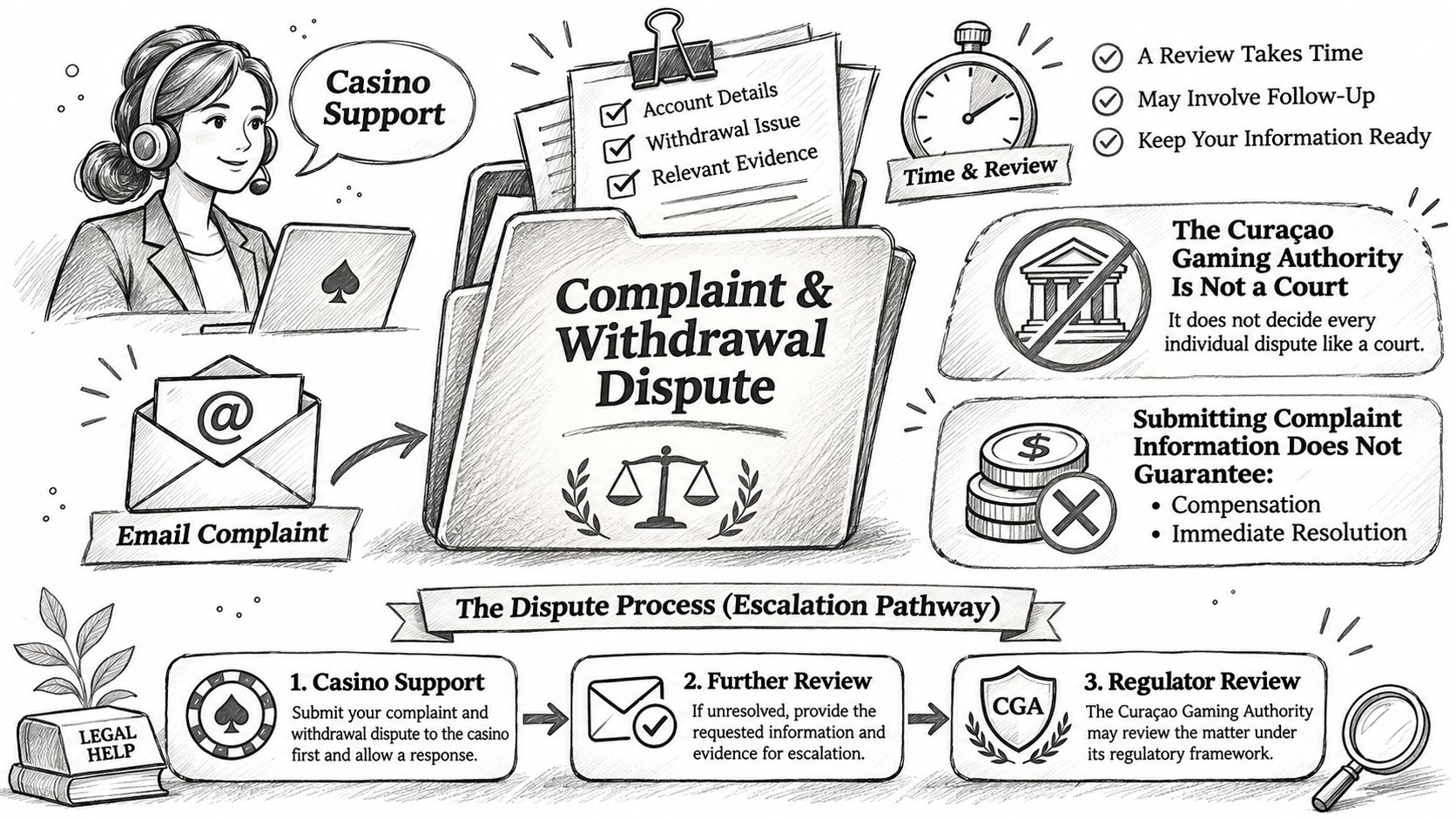
Build an evidence file. Include the license reference, account identifier, withdrawal history, transaction IDs, relevant terms, screenshots, and identity-check correspondence. Preserve self-exclusion requests if they're relevant, but never share wallet seed phrases or private keys.
Submit a written complaint. Use the operator's formal complaint channel and keep a dated copy. State the disputed amount or action, the sequence of events, and the remedy you want.
Track the response. Record acknowledgement, requests for further information, the decision, and any explanation of an extension. Keep support transcripts rather than relying on recollection.
Use the designated ADR channel. If the operator's decision doesn't resolve the complaint, follow its certified alternative dispute resolution procedure. Preserve the submission and outcome.
Separate regulatory reporting from recovery. Report suspected license-condition breaches to the CGA. A civil claim to recover money is a separate route that may require jurisdiction-specific legal advice.
What deadlines apply?
The Legal 500 Curaçao gambling-law guide describes acknowledgement within one week, a decision within four weeks, a possible four-week extension, and access to ADR at the operator's expense.
Complaint deadlines under the post-LOK framework
| Stage | Deadline | Who acts |
|---|---|---|
| Complaint sent to operator | Day 0 | Player, with evidence |
| Acknowledgement | Within one week | Operator |
| Decision | Within four weeks | Operator |
| Extension | Possible four more weeks | Operator |
| Alternative dispute resolution | After the operator's decision | Operator provides access, at its expense |
These are complaint-handling stages, not promised payout speeds. Our fast-withdrawal casino guide addresses withdrawal considerations, but a marketing description doesn't replace the complaint procedure.
A regulatory breach and a recoverable civil claim may concern the same events, but they aren't the same remedy.
The framework is still being put into practice. Check current complaint rules, implementation requirements, and the operator's designated ADR arrangements before relying on a deadline or escalation route.
Apply the Checks Before You Deposit
Consider a player in a country that restricts offshore gambling. The casino displays a plausible Curaçao badge, its games load, and the cashier accepts the player's cryptocurrency. The next action should be checking local law, not testing whether a deposit goes through.
Consider another player whose withdrawal stalls after an identity-document request. A confirmed on-chain deposit doesn't explain the pending withdrawal review. The useful request is for written confirmation of outstanding documents, the review stage, and the applicable processing policy.
A third player finds a certificate issued during the licensing transition. Rather than deciding from the certificate's appearance, the player checks the reference and present status with the CGA. Until that match is established, depositing would mean acting on an unresolved claim.
What should your pre-deposit routine include?
Confirm the authorization. Match the legal entity, reference, domain, and current status, and establish that the scope covers online gaming. Save the official information with the date of your check. If company names conflict, resolve the discrepancy before sending funds.
Confirm your local eligibility. Check official guidance for your country and any applicable local authorization requirement. Include legal age, location restrictions, payment rules, and tax obligations in your assessment. Don't use a VPN or an inaccurate address to work around restrictions.
Read identity and withdrawal terms together. Identify the documents the operator may request, how withdrawals are reviewed, applicable charges, and any payment-method conditions. If a bonus is involved, read its wagering and withdrawal conditions before accepting it. Save the terms that apply to your account rather than relying on a promotional summary.
Set deposit limits before playing. Choose an amount you can afford to lose without affecting bills, savings commitments, or other necessities. Find the self-exclusion controls before you need them. If the available controls don't support the boundaries you want, don't proceed.
Deposit only after those checks are complete. An unresolved legal, identity, or licensing question is a reason to stop, not a reason to send a smaller test payment. A successful payment wouldn't resolve the underlying uncertainty.
How should you use an editorial ranking?
Our CryptoGameRank index is marked 18+ only and is an editorial starting point, not a gambling service or a recommendation to participate. Ranking entries aren't promises of suitability, and we ask readers to research platforms independently and check the requirements where they live.
Our reviews are public-source overviews, not tested casino endorsements. We didn't open accounts, make deposits, or test payouts when reviewing platforms. That distinction matters when you're deciding how much weight to give an editorial description compared with an official license record or an operator's current terms.
You make the final decision, including the decision not to gamble. A shortlist can organize research, but it can't establish your legal position, confirm future payment outcomes, or determine what financial risk is acceptable for you.
Before committing funds: Keep a record of what you verified, what remains uncertain, and why you're comfortable proceeding. If an essential question remains unanswered, pause.
When should you stop?
Gambling is for adults aged 18 and over, subject to any higher local legal-age requirement. Treat it as paid entertainment with a possible complete loss of the amount committed, not as income or a way to repair finances.
Our responsible-play guidance is straightforward: set limits, never chase losses, and seek support if gambling stops feeling like entertainment. Contact local gambling-support services or a healthcare professional if you're struggling to stop, borrowing to play, or hiding gambling from people close to you.
Finally, revisit the official license record before each new deposit, because status can change. A screenshot preserves what you checked previously; it doesn't establish today's position.
CryptoGameRank offers editorial guides and public-source platform overviews to help adults organize independent research. Visit CryptoGameRank to compare that information with your own licensing, eligibility, and terms checks before deciding whether to participate.